
Quick answer: Eco-friendly building block toys made from sustainable wood or magnetic materials are safer, more durable, and better for the environment than standard plastic sets. Look for certifications like FSC, EN71, or ASTM, choose sets matched to your child’s age and skill level, and use structured play sessions to maximize STEM learning outcomes.
Every parent has stood in a toy aisle — or scrolled through an endless product page — wondering which building toys are actually worth buying. Not just for entertainment, but for development, safety, and longevity. The answer, increasingly, points toward eco-friendly building block toys: sets built from sustainable materials, designed to last, and engineered to stretch a child’s imagination further than a screen ever could.
This guide covers everything you need to know. From identifying genuinely sustainable toys to getting the most out of wooden building block toys and magnetic building block toys, you’ll walk away with practical strategies for choosing, setting up, and using block toys that make playtime count — for your child and the planet.
Whether you’re a parent shopping for a five-year-old, a grandparent hunting for a meaningful gift, or a builder looking for a creative alternative to mainstream plastic sets, this is your definitive reference.
Why Choose Eco-Friendly Building Block Toys?
The case for going eco-friendly extends well beyond aesthetics. It starts with what your child touches every day.
Conventional plastic building toys are typically made from ABS plastic — a petroleum-derived material that’s durable, yes, but resource-intensive to produce and slow to decompose. When the toy breaks or loses its novelty, it usually ends up in landfill.
Eco-friendly building block toys flip this equation. Sourced from sustainably managed forests or recycled composites, they reduce manufacturing emissions, biodegrade more responsibly, and — critically — contain fewer synthetic chemicals. This matters for parents of younger children, who are more likely to mouth or handle toys extensively.
Beyond environmental impact, there are developmental advantages. Research consistently links open-ended block play to improvements in:
- Spatial reasoning — the ability to mentally rotate and manipulate shapes
- Mathematical thinking — pattern recognition, symmetry, and early geometry
- Executive function — planning, problem-solving, and self-regulation
- Fine motor development — grip strength, hand-eye coordination, and dexterity
According to a study published in Child Development (2018), children who engaged in regular block play demonstrated measurably stronger early math skills compared to control groups. The material doesn’t determine these outcomes — but wooden building block toys and magnetic building block toys, by virtue of their tactile richness and open-ended design, tend to sustain longer, more varied play sessions than single-function plastic toys.
How to Identify Truly Eco-Friendly Building Block Toys
The word “eco-friendly” appears on a lot of packaging. Not all of it is earned. Here’s how to cut through the noise.
What certifications actually matter?
When evaluating eco-friendly building block toys, look for third-party certifications rather than self-declared claims:
- FSC (Forest Stewardship Council) — confirms wood is sourced from sustainably managed forests
- EN71 — the European toy safety standard; mandatory in the EU market
- ASTM F963 — the U.S. equivalent for toy safety
- OEKO-TEX Standard 100 — certifies textiles and materials are free from harmful substances
- CPSC compliance — U.S. Consumer Product Safety Commission requirements for imported toys
A toy marketed as “natural” without any of these marks deserves skepticism.
What materials should you look for?
Genuinely sustainable block toys use:
- FSC-certified hardwood or rubberwood — dense, splinter-resistant, and long-lasting
- Water-based or food-grade paints and stains — free from lead, phthalates, and BPA
- Natural rubber or plant-based composites for softer components
- Recycled or biodegradable packaging
Avoid sets with strong chemical odors, poorly sanded edges, or paint that chips easily — these are warning signs that safety standards may not have been met.
How to Choose the Right Wooden Building Block Toys for Your Child
Wooden building block toys have been a childhood staple for centuries — and for good reason. Wood is tactile, warm, and forgiving. A dropped wooden block doesn’t shatter. A well-made set can pass from one child to the next without losing structural integrity.
But not every wooden set suits every child. Here’s how to match the toy to the builder.
Matching block sets to age and skill level
| Age Range | Recommended Type | Key Features |
|---|---|---|
| 1–3 years | Large unit blocks, stacking cubes | Chunky, rounded edges, simple shapes |
| 3–5 years | Classic unit blocks, pattern boards | Multiple shapes, color sorting potential |
| 5–8 years | Architectural sets, interlocking planks | Greater complexity, more pieces |
| 8+ years | Advanced construction kits | Fine detail, design challenges |
What to prioritize when buying wooden sets
- Consistency of cut — blocks should be precise multiples of each other (e.g., a double unit is exactly twice a single unit). Inconsistency frustrates building and undermines mathematical learning.
- Smooth finish — run your hand across every surface before purchasing. Rough grain or visible seams are quality red flags.
- Weight — heavier hardwood blocks feel more satisfying to stack and are harder to knock accidentally. They also signal denser, more durable material.
- Variety of shapes — sets including cylinders, arches, and triangular prisms encourage more complex building than sets with rectangles alone.
For a curated range of wooden building block toys designed with precision and sustainability in mind, explore the ModelBuilder collection at modelbuilderus.com.
How to Get the Most Out of Magnetic Building Block Toys
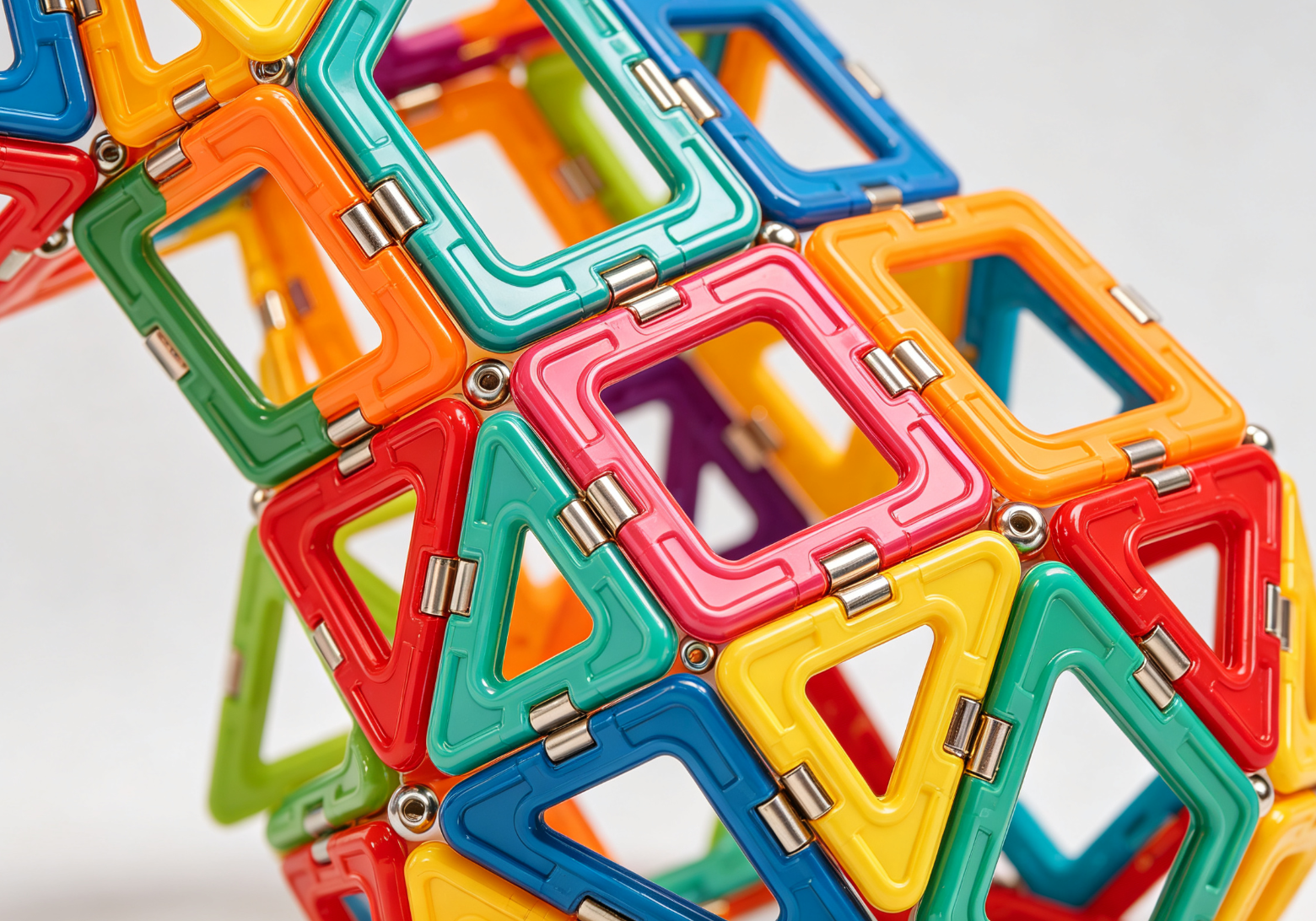
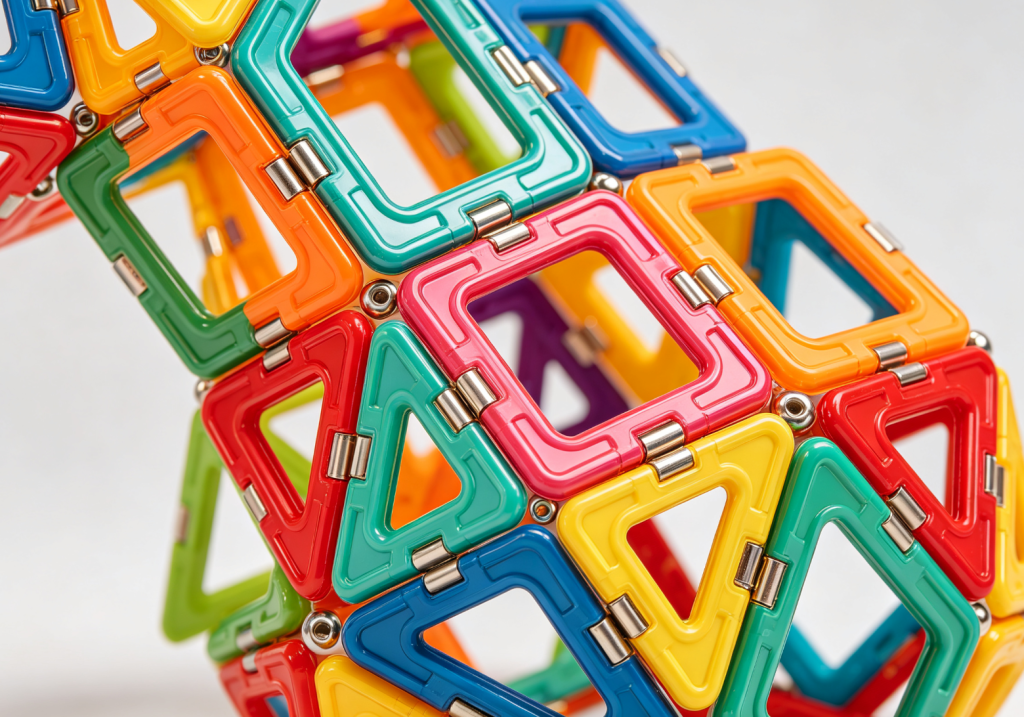
Magnetic building block toys operate on a different principle — and unlock a different kind of creativity. Instead of stacking and balancing, children connect flat or three-dimensional tiles along magnetized edges, building structures that are both stable and visually striking.
Why magnetic blocks develop different skills
The self-correcting nature of magnetic connections lowers the barrier to complex building. A child who might topple a traditional arch accidentally can hold a magnetic arch in place while adding the next section. This reduces frustration and extends the session — both important for sustained learning engagement.
Magnetic building block toys are particularly effective for:
- Geometric exploration — triangles, squares, and pentagons snap together to form 3D polyhedra
- STEM experimentation — children naturally investigate which shapes create stronger structures
- Collaborative building — the forgiving magnetic connection makes it easier for two children (or a parent and child) to build together
Safety first: what to watch for
Magnetic toys carry a specific risk: if a set contains loose or low-quality magnets that can be swallowed, the results can be medically serious. In both the EU and U.S., magnetic toy regulations have tightened significantly. When shopping, verify that:
- The set complies with EN71-1 (EU) or ASTM F963 (U.S.)
- Magnets are fully encased and cannot be separated from the tile
- The set is age-rated 3+ at minimum; avoid magnetic tiles entirely for children under 3
Premium magnetic tile brands typically use neodymium magnets encased in ABS or PP plastic shells with double-sealed edges. Always read the small print.
Step-by-Step Guide: Setting Up and Playing with Building Block Toys
Getting blocks out of the box is easy. Getting genuine developmental value from them takes a little more intention.
Step 1: Prepare the play space
Clear a low, flat surface — ideally a large foam mat or a clean hardwood floor. Carpet introduces friction that can frustrate younger builders. Remove unrelated toys from the area to reduce distraction and encourage focused building.
Step 2: Introduce the set gradually
Don’t pour 200 blocks out at once. Start with a smaller selection — 20 to 30 pieces — and let your child explore without instruction. Observe which shapes they reach for first and what they attempt to build.
Step 3: Model without directing
Sit alongside your child and build something of your own. Narrate what you’re doing without telling them what to do. “I’m putting the arch here because I want a door” invites imitation without imposing it.
Step 4: Introduce a challenge
Once a child is comfortable with the set, add a light prompt: “Can you build something taller than that bottle?” or “What can you make using only triangles?” Challenges extend sessions and push spatial thinking further.
Step 5: Document and celebrate
Photograph finished builds. Encourage children to name their creations and explain what they built. This adds a language and narrative layer to the physical activity — and gives young builders a genuine sense of accomplishment.
Tips for Parents: Making Playtime Educational and Fun
Block play is inherently educational. But a few deliberate habits amplify those benefits significantly.
Rotate sets regularly. Novelty sustains engagement. Storing half the blocks and reintroducing them after two weeks creates a “new toy” effect without buying anything new.
Mix block types. Combining wooden building block toys with magnetic building block toys in a single session introduces constraint-based thinking — certain shapes connect magnetically, others balance mechanically. Children learn to use each system’s strengths.
Use math language naturally. Count pieces aloud. Name shapes. Compare heights (“that one is taller,” “these are the same”). Children absorb mathematical vocabulary through casual, repeated exposure.
Avoid over-praising the outcome. “You worked really hard on that” builds resilience more effectively than “that’s amazing.” Process praise encourages children to attempt harder builds rather than resting on safe successes.
Let them fail. A collapsing tower is data. Children who rebuild after a failure learn more than children who build something easy and leave it standing.
ModelBuilder: A Sustainable LEGO Alternative
For builders who want more than a generic box of blocks, ModelBuilder offers an alternative that takes both creativity and sustainability seriously.
ModelBuilder designs building block sets for enthusiasts of all ages — from young children developing spatial skills to adult collectors working on detailed architectural models. Every set goes through a four-stage process: design concept, material selection, prototype development, and production — with eco-friendly materials at each step.
The range includes:
- Custom brick sets — tailored builds designed for individual preferences
- Themed collections — architecturally inspired and imaginative sets that go beyond standard rectangular bricks
- Educational workshops — interactive formats designed to build problem-solving skills alongside physical structures
ModelBuilder occupies a growing category: eco-friendly building block toys that don’t ask builders to trade quality for conscience. The sets are crafted for durability, designed for replayability, and built on the understanding that a great building toy should outlast a single afternoon.
Rated highly by builders across both the U.S. and European markets, ModelBuilder is the kind of brand that earns a permanent spot in the toy cabinet — not just the gift pile.
Explore the full range and find the set that fits your builder at modelbuilderus.com.
The Right Block. The Right Builder. The Right Choice.
Choosing between eco-friendly building block toys, wooden building block toys, and magnetic building block toys doesn’t have to be complicated. Match the material to the builder’s age and temperament. Verify safety certifications before you buy. Set up play sessions with intention, and then step back and let curiosity take over.
The best building toy isn’t necessarily the most expensive or the most elaborate. It’s the one your child returns to — the one that survives a move, a sibling, and five years of daily use. That’s the standard worth building toward.
Frequently Asked Questions
What age is best to start with eco-friendly building block toys?
Eco-friendly building block toys can be introduced from 12 months, starting with large, smooth unit blocks. Magnetic tiles are appropriate from around age 3, once a child has outgrown the mouthing stage. Always check the manufacturer’s age rating and verify safety certifications (EN71 or ASTM F963) before purchasing for younger children.
Are wooden building block toys safer than plastic ones?
Wooden building block toys made from FSC-certified hardwood with water-based paints are generally considered safer than standard plastic sets, primarily because they avoid synthetic chemicals like BPA and phthalates. That said, safety depends on manufacturing quality — always check for relevant certifications regardless of material.
Can magnetic building block toys be used alongside wooden sets?
Yes. Combining magnetic building block toys with wooden sets in a single session can enrich play by introducing different structural constraints. Children learn which connection type suits each part of a build — a valuable exercise in problem-solving and material thinking.
How do I know if a toy’s “eco-friendly” claim is genuine?
Look for independent third-party certifications: FSC for wood sourcing, EN71 or ASTM F963 for safety, and OEKO-TEX 100 for material purity. Self-declared eco claims without supporting certification carry no formal verification and should be treated with caution.
What makes ModelBuilder different from standard LEGO alternatives?
ModelBuilder focuses on sustainable material selection, precision engineering, and creative versatility — offering custom brick sets, themed collections, and educational formats that go beyond traditional rectangular bricks. The brand serves builders from early childhood through adult collection, making it a longer-term investment than most single-range alternatives.