
Introduction: When Building Becomes More Than Just Following Instructions
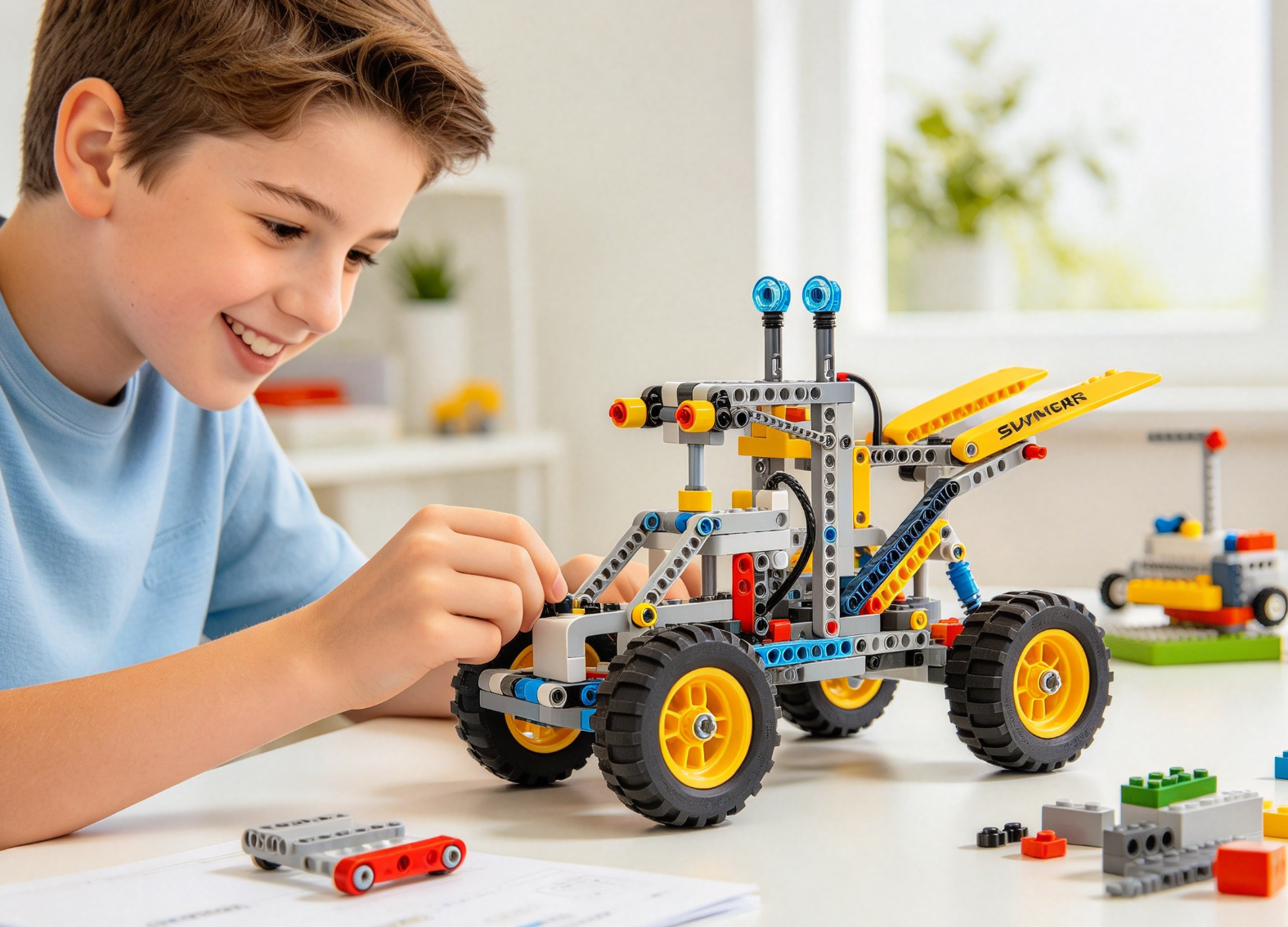
There is a particular moment when a child starts looking at a building set differently. Instead of asking, “What does the instruction booklet tell me to build?”, they start asking, “What else could I make with these pieces?”
For many children around ten or eleven, this change marks an exciting stage in their relationship with construction toys.
They may have already built dozens of cars, houses, robots, and spaceships. They understand how individual pieces connect, recognize common building techniques, and are increasingly comfortable working through complicated instructions. But simply repeating familiar projects may no longer be enough.
They want something more challenging. They want models that look impressive, mechanisms that actually work, and designs that reflect their own ideas.
This is where choosing the right building set becomes particularly important.
The best building toys for 10 year olds and building toys for 11 year olds should offer more than a large number of pieces. They should introduce meaningful challenges, encourage independent decisions, and give children opportunities to experiment beyond the original instructions.
For parents in the United States and Europe, there is also another consideration: finding construction toys that balance quality, educational value, creative freedom, and affordability.
In this guide, we will explain how to choose advanced building sets, introduce practical engineering challenges, and show how to turn a regular building collection into a long-term creative hobby.
Whether you are shopping for a birthday, Christmas, a school holiday, or simply looking for a more engaging screen-free activity, these ideas will help you make a smarter choice.
1. Understand the Transition from Young Builder to Independent Designer
Ten and eleven are interesting ages because children are beginning to develop stronger personal preferences about how they spend their free time.
Some become passionate about mechanical systems. Others enjoy architecture, vehicles, fantasy worlds, or highly detailed display models.
The difference between these age groups is not necessarily the number of pieces they can assemble. It is often the kind of thinking they want to apply to a project.
What Makes Building Toys Suitable for 10-Year-Olds?
Many ten-year-olds are comfortable following multi-stage instructions and managing projects that involve several different types of components.
They may also begin to notice the relationship between individual design choices and the performance of a finished model.
For example, when building a car, they might consider:
- Why are the wheels positioned at a particular distance?
- How can the body be made more stable?
- Can the doors open without weakening the structure?
- What happens when the vehicle becomes longer or heavier?
These questions make this an excellent time to introduce more detailed construction sets.
Look for projects that combine recognizable models with opportunities for customization. A vehicle that can be modified, a building with removable sections, or a robot with adjustable features can offer more lasting interest than a model that only has one possible outcome.
What Should Building Toys Offer 11-Year-Olds?
By eleven, many experienced builders are ready for more demanding projects.
They may enjoy larger structures, intricate mechanical details, realistic vehicles, or models that require careful planning before assembly.
Some children also begin to care about the finished model as an object they can display.
This creates an interesting combination of interests: they want the satisfaction of completing a complicated project, but they also want the final result to look impressive.
When comparing building toys for 11 year olds, consider:
- Detailed construction techniques.
- More complicated connections and structural arrangements.
- Functional features such as steering, rotating components, or moving sections.
- Realistic proportions and decorative details.
- Opportunities to rebuild or customize the finished model.
Not every eleven-year-old wants the most difficult set available. Some prefer a detailed model that takes several evenings to complete, while others enjoy creating something entirely original.
The best choice depends on the individual builder, not simply the age printed on the packaging.
2. Choose the Right Type of Advanced Building Toy
One reason older children sometimes lose interest in construction toys is that they keep receiving the same kind of set.
A child who has already built several standard vehicles may not be excited by another basic car. However, introducing a new construction style can make familiar building pieces feel interesting again.
Here are five categories worth exploring.
A. Mechanical Building Sets
<PRIVATE_PERSON>Mechanical construction is a natural next step for children who want to understand how things work.
These sets may include gears, axles, hinges, rotating joints, and other components that introduce the relationship between moving parts.
Instead of simply creating an attractive model, children can explore how mechanical elements interact.
For example, a simple gear system can demonstrate how rotational movement transfers between connected components.
Try asking your child to build two connected gears and observe what happens when one is turned.
Then introduce a challenge: can they design a mechanism that makes a second component rotate in the opposite direction?
This type of project encourages experimentation and gives children a reason to examine the structure rather than just the finished appearance.
B. Vehicle and Transportation Models
Cars, motorcycles, aircraft, construction vehicles, and trains remain popular choices among older builders.
However, at ten and eleven, the attraction often shifts toward realistic details.
Children may appreciate opening doors, adjustable components, detailed cockpits, steering systems, and recognizable mechanical features.
Vehicle projects also create opportunities to explore proportion and structural design.
A useful challenge is to ask your child to build two vehicles using a similar number of pieces but with completely different purposes.
For example, one could be designed for speed, while the other is built to transport heavy cargo.
The two models will require different design decisions, even though they use the same basic building materials.
C. Architecture and Engineering Sets
Some young builders prefer creating structures rather than machines.
Advanced architectural projects can include bridges, towers, stadiums, houses, and miniature city environments.
These models encourage children to think about stability, symmetry, scale, and structural support.
Rather than simply copying a building from a picture, encourage them to choose a real-world structure as inspiration.
They could recreate a famous bridge, design a modern home, or invent a sustainable city.
For an additional challenge, introduce a limited building area. Ask them to fit as many useful features as possible into a defined footprint.
This turns an ordinary construction activity into a small design exercise.
D. Robotics-Inspired Construction
Robotics themes are particularly appealing to children interested in technology.
Even without introducing programming or electronics, building a robot encourages them to think about how different parts work together.
A well-designed robot model might include:
- Movable arms.
- Adjustable legs.
- A rotating head.
- Storage compartments.
- A reinforced body.
- A special tool for completing a particular task.
The important part is giving the robot a purpose.
Ask your child to create a machine designed to help with an imaginary problem, such as exploring a distant planet or collecting materials after a natural disaster.
This connects physical construction with creative problem-solving.
E. Display-Worthy Collector Models
Not every construction activity needs to involve movement or experimentation.
Some children genuinely enjoy creating detailed models that look impressive on a shelf.
They may spend hours adjusting small decorative elements, matching colors, or making sure the proportions look right.
For these builders, a detailed model with an interesting subject can be more appealing than an open-ended set.
Consider their interests before choosing. A child fascinated by classic cars may appreciate a realistic vehicle model, while a space enthusiast may prefer a spacecraft or futuristic installation.
A good display model can also become a starting point for a larger collection.
3. Evaluate Building Difficulty Beyond the Number of Pieces
A common mistake when shopping for older children is assuming that more pieces automatically mean a better construction experience.
Piece count is useful, but it does not tell you how demanding or enjoyable a project will be.
A model containing 500 repetitive pieces may be relatively straightforward. Another model containing fewer pieces could require much more careful assembly because of its unusual geometry or mechanical connections.
Here are four factors to consider.
Look at Construction Techniques
Does the set introduce techniques that the child has not encountered before?
New connection methods, angled structures, layered designs, and moving components can make a project more challenging without simply making it larger.
A good advanced set should expand a child’s building skills rather than repeat the same assembly pattern hundreds of times.
Examine the Instruction Booklet
For older builders, instructions should provide enough detail to make complicated construction manageable.
Check whether the product includes:
- Clearly separated assembly stages.
- Accurate illustrations.
- Detailed placement of specialized components.
- Logical construction sequences.
- Guidance for more complicated connections.
If your child enjoys working independently, instructions should be understandable without requiring an adult to explain every stage.
Consider Project Length
A long project can be rewarding, but only if it matches the child’s patience and schedule.
Some children enjoy building a detailed model over several days. Others prefer completing a project in one or two sessions.
Think about how your child usually approaches hobbies.
Do they enjoy concentrating on one task for a long time, or do they prefer switching between several smaller activities?
Matching project length to their habits can make a significant difference.
Check Rebuilding Potential
Perhaps the most valuable question is what happens after the model is finished.
Can the pieces be reused in another design? Are there alternative construction possibilities? Can children modify important sections without dismantling everything?
A set with good rebuilding potential can remain interesting long after the first assembly is complete.
4. How to Turn Advanced Building Sets into Real Engineering Challenges
One of the best ways to keep older children interested is to stop treating the instruction booklet as the final destination.
Instead, introduce a design problem that requires them to make decisions, test their ideas, and improve the result.
Here are five challenges designed specifically for more experienced builders.
Challenge 1: Build a Functional Crane
<PRIVATE_PERSON>Construction cranes are fascinating because they combine structure, balance, and movement.
Ask your child to build a small crane that can lift a lightweight object from the table.
The model should include a stable base, a vertical support, and an arm extending outward.
How to complete the challenge:
- Build a stable foundation.
- Add a vertical support structure.
- Create an extended crane arm.
- Introduce a simple lifting mechanism using string or another suitable component.
- Test the crane with a lightweight object.
- Adjust the design if the structure tilts or becomes unstable.
What children can explore:
They can investigate how the position of the load affects balance and why a wider foundation may improve stability.
For a more advanced version, introduce a rule that the crane must lift an object from a specific distance without moving its base.
Challenge 2: Design a Multi-Level Parking Garage
This is a great project for children who enjoy vehicles and architecture.
The goal is to create a parking garage that can accommodate several miniature vehicles while using the available space efficiently.
Introduce a few design requirements:
- At least two parking levels.
- A ramp connecting the floors.
- A clear entrance and exit.
- Space for different vehicle sizes.
- A structure that remains stable during play.
Encourage your child to sketch the design before building.
Once the garage is complete, test whether the vehicles can move between floors.
This introduces an important design lesson: a structure can look impressive but still fail if its layout is not practical.
Challenge 3: Build a Mechanical Gear System
A gear challenge is ideal for children who enjoy understanding how individual components interact.
Give them several compatible gears and ask them to create a simple transmission system.
Start with two connected gears.
Observe their direction of rotation, then experiment with different gear sizes or additional connected components.
Ask:
- Which gear turns faster?
- What happens when another gear is added?
- Can the movement be transferred around a corner?
- How does changing the arrangement affect the system?
The goal is to encourage observation and logical reasoning.
If the set does not include functional gears, children can still explore mechanical design through rotating wheels, axles, and movable joints.
Challenge 4: Create a Disaster-Resistant Building
Imagine that your child has been asked to design a building for an area that experiences strong winds.
Their task is to create a structure that can remain standing during a controlled stability test.
Ask them to consider:
- The width of the base.
- The height of the building.
- The position of supporting walls.
- The distribution of heavier components.
- The use of cross-bracing.
After completing the model, introduce a gentle, consistent test using a small movement of the building surface.
Compare the results after changing one design feature at a time.
This activity teaches an important engineering principle: improving one part of a structure can sometimes affect the performance of the entire design.
Challenge 5: Invent a Product That Solves an Everyday Problem
This is perhaps the most open-ended challenge.
Instead of giving your child a model to copy, ask them to identify a small problem that a designed object could solve.
For example:
- A desk organizer that saves space.
- A miniature delivery vehicle.
- A movable storage system.
- A machine that sorts small objects.
- A modular home for miniature figures.
Give them a simple design brief:
“Create something that solves a real problem, explain how it works, and show why your design is better than the first version.”
This encourages children to think like designers rather than simply model builders.
5. Introduce the Engineering Design Process at Home
For experienced builders, one of the most useful changes parents can make is introducing a repeatable design process.
Professional engineers rarely expect their first design to be perfect. They create prototypes, test them, identify weaknesses, and improve them.
Children can follow the same basic approach with building bricks.
Step 1: Define the Problem
Start with a clear objective.
For example, build a bridge that can connect two supports while using a limited number of pieces.
Avoid giving too many instructions. The challenge should leave room for the child to make decisions.
Step 2: Plan Before Building
Encourage the child to sketch a basic design.
It does not need to be a professional drawing. Even a simple side view can help them understand the intended shape and arrangement.
Ask them to identify the most important parts before beginning.
Step 3: Build a Prototype
The first version does not need to be beautiful.
Its purpose is to test whether the basic idea works.
Encourage children to use available pieces rather than waiting for the perfect components.
Step 4: Test and Record Results
Introduce a simple testing process.
For example, if the project is a bridge, record how much lightweight material it can support.
If it is a vehicle, observe how consistently it travels down the same ramp.
Taking photographs or keeping a small notebook can make the process more interesting.
Step 5: Improve the Design
Ask the child to identify one weakness and change one feature.
Testing one change at a time makes it easier to understand what actually improved the model.
Step 6: Present the Finished Project
Invite your child to explain the final design.
They can describe the original problem, the challenges they encountered, and what they changed.
This final stage gives the project a sense of achievement and helps develop communication skills alongside construction skills.
6. How to Choose Quality LEGO Alternatives for Older Children
LEGO is one of the most recognizable names in the construction toy market, but families have many other options when shopping for building sets.
Alternative building brands can offer different themes, model designs, and price points.
For parents of ten- and eleven-year-olds, exploring these alternatives can be particularly useful because older children often have more specific interests.
One child may want a detailed vehicle. Another may prefer a fantasy-inspired model or a complex architectural project.
Choosing the right design can matter more than choosing the most famous brand.
What Should Parents Compare?
1. Connection quality
Building components should connect consistently and remain secure during ordinary assembly and play.
Poorly fitting pieces can make complicated projects unnecessarily frustrating.
2. Material information
Look for clear information about materials, manufacturing, and product quality.
For plastic building bricks, product-specific material information is more useful than vague claims about premium quality.
3. Design originality
Does the set offer something interesting beyond the same familiar model themes?
Unique designs can help experienced builders discover new interests.
4. Instructions and support
Detailed instructions are especially important for complex models.
Check whether the manufacturer provides clear assembly guidance and customer support for missing or damaged components.
5. Compatibility
If your child already owns interlocking bricks from another brand, compatibility may influence your purchase.
Do not assume that all alternative building systems are interchangeable. Check the specific product information before combining collections.
Why Consider ModelBuilder?
ModelBuilder is a brand focused on alternative building blocks for families and creative builders who want more options beyond traditional LEGO collections.
Its custom brick sets and themed collections provide another starting point for exploring different construction projects.
For parents comparing alternatives, the most useful approach is to evaluate each ModelBuilder set according to its actual design, age recommendation, component details, and building experience.
The goal is not simply to find a cheaper replacement. It is to find a construction project that genuinely interests the child and offers an enjoyable building experience.
You can explore our block building toys guide to learn more about different building formats, construction styles, and creative possibilities.
7. How to Make Building Toys Feel More Like a Serious Hobby
By ten or eleven, children may enjoy treating their favorite activities as personal hobbies rather than occasional playtime.
This creates an opportunity to make construction more meaningful without turning it into another school assignment.
Create a Dedicated Building Workspace
A permanent building area can make longer projects easier to manage.
It does not need to be a large workshop.
A desk, a flat table, or a small section of a bedroom can work well.
Consider adding:
- Small containers for sorting components.
- A flat surface for keeping unfinished models.
- A notebook for sketches and design ideas.
- A ruler for measuring structures.
- A small display area for completed projects.
Having a dedicated space allows children to pause a complicated build and return to it later.
Introduce a Personal Project Portfolio
Encourage children to photograph their best creations.
They can save the pictures in a digital folder or create a simple physical scrapbook.
For each model, ask them to record:
- The name of the project.
- What inspired the design.
- The main challenge.
- What worked well.
- What they would improve next time.
Over time, this becomes a record of their progress.
Children can look back at earlier designs and see how their construction skills have developed.
Let Them Lead the Project
One of the biggest mistakes adults make is taking over when a child encounters a difficult building problem.
It is tempting to fix a weak structure immediately, but doing so removes an opportunity for independent problem-solving.
Instead of providing the answer, ask a question.
“What do you think is causing that section to move?”
“Would changing the support position help?”
“Can you find another way to connect these two parts?”
The child should remain responsible for the design decisions.
8. Check Safety, Materials, and Regional Requirements Before Buying
Advanced construction sets often contain smaller components and more specialized parts than beginner products.
Although ten- and eleven-year-olds can generally manage more detailed construction projects, parents should still review product information carefully.
Check Age Recommendations
Always follow the manufacturer’s recommended age range.
A set designed for older children may contain small pieces, specialized connectors, or other components that are unsuitable for younger siblings.
Consider the actual household environment, not just the intended builder.
Understand US and European Toy Safety Requirements
For the US market, parents should look for applicable toy safety information, including compliance with ASTM F963 and relevant Consumer Product Safety Commission requirements.
For the European market, check the applicable EU toy safety requirements, relevant EN 71 standards, and CE marking where required.
These requirements should be supported by appropriate product documentation rather than assumed from a brand’s marketing claims.
Consider Material Durability
Older children may dismantle and rebuild the same model many times.
For this reason, durable components and consistent connections are particularly important.
Review product specifications and, where available, independent customer feedback about how well the pieces hold together after repeated use.
Think About Storage
A complex building project can involve hundreds of small components.
A good storage system helps prevent lost pieces and makes future rebuilding easier.
Transparent containers, labeled compartments, and separate spaces for specialized components are practical solutions.
For more ideas on selecting suitable products and comparing construction toy features, see our guide to choosing construction toys for kids.
9. A Four-Week Advanced Building Challenge for Tweens
If your child already owns several building sets, a structured monthly project can provide a new reason to use them.
Rather than completing four unrelated models, organize the activities around one larger theme: designing a miniature future city.
This project works especially well for children aged ten and eleven because it combines architecture, transportation, mechanical thinking, and creative planning.
| Week | Main Project | Design Objective |
|---|---|---|
| Week 1 | Design a Modern Building | Create a stable structure with multiple levels |
| Week 2 | Build a Transportation System | Connect different areas of the city |
| Week 3 | Invent a Working Machine | Add a mechanical feature to the environment |
| Week 4 | Create the Complete City | Combine the individual models into one system |
Week 1: Design the Main Building
Ask your child to create a building with a specific purpose, such as a research center, apartment complex, or futuristic library.
Encourage them to think about space, stability, and appearance.
Week 2: Connect the City
Introduce roads, bridges, parking areas, or railway systems.
The goal is to make the different sections of the city feel connected rather than simply placing separate models beside each other.
Week 3: Add a Mechanical Feature
Create a crane, rotating sign, movable gate, or another feature that introduces movement.
The mechanism does not need to be complicated. It should simply serve a purpose within the larger design.
Week 4: Present the Final Creation
Bring all the sections together.
Ask your child to explain how the city works, why they made certain design choices, and what they would add if they had another month.
Take photographs of the final project.
This kind of long-term activity demonstrates the real advantage of reusable building toys: one collection can support multiple projects, rather than being limited to a single finished model.
Conclusion: Give Older Builders the Freedom to Think Bigger
Choosing building toys for ten- and eleven-year-olds requires a slightly different approach from buying sets for younger children.
At this age, many children want more than colorful pieces and straightforward instructions. They want detailed models, meaningful challenges, functional designs, and the freedom to create something that feels genuinely their own.
For ten-year-olds, a combination of structured construction and customization can provide an excellent balance.
For eleven-year-olds, more advanced mechanical projects, realistic models, and independent design challenges may offer greater long-term appeal.
However, the most important consideration remains the child’s individual interests and experience.
A great building set should make a child curious about what they can create next. It should encourage them to experiment, question their decisions, and discover that a failed design is simply an opportunity to try another approach.
At ModelBuilder, we believe that building is not just about completing a model. It is about giving creative minds the pieces, possibilities, and inspiration to make something original.
Because the most exciting project is often the one that starts after the instructions have run out.
Frequently Asked Questions (FAQs)
1. What Are the Best Building Toys for 10 Year Olds?
The best choices include mechanical building sets, detailed vehicles, architectural models, robotics-inspired construction kits, and open-ended brick collections. Look for products that offer meaningful building challenges, clear instructions, and opportunities to modify the finished design.
2. What Are Good Building Toys for 11 Year Olds Who Already Have LEGO Sets?
Experienced eleven-year-old builders may enjoy advanced mechanical models, realistic vehicle kits, architectural projects, and alternative building brands with different themes. Choose sets that introduce new construction techniques or offer more customization rather than simply repeating projects they have already completed.
3. How Many Pieces Should a Building Set Have for a 10- or 11-Year-Old?
There is no fixed ideal number. Some children enjoy sets with a few hundred pieces, while experienced builders may prefer much larger projects. Consider the construction techniques, instruction complexity, building time, and replay value rather than using piece count as the only measure of difficulty.
4. Are Building Toys Suitable for STEM Learning at Ages 10 and 11?
Absolutely. Advanced construction activities can introduce practical concepts related to engineering, geometry, mechanical movement, structural stability, and problem-solving. Activities that involve designing, testing, and improving a model can make these concepts easier to understand through hands-on experience.
5. Are ModelBuilder Building Blocks a Good Alternative to LEGO?
ModelBuilder offers alternative building block collections for families interested in exploring different construction themes and designs. When selecting a set, compare its component details, product-specific compatibility information, age recommendations, instructions, and material specifications to determine whether it suits your child’s building experience.