
Quick answer: The best building toys for 2 year olds use oversized, chunky pieces that are easy to grip and impossible to swallow, while the best building toys for 3 year olds add smaller pieces, simple instructions, and early shape-matching challenges. Choosing the right set at each stage supports motor skills, problem-solving, and screen-free play time.
Choosing a building toy for a toddler is not the same as choosing one for an older child. A two-year-old needs pieces built for small hands and short attention spans. A three-year-old is ready for a bit more structure and a few more steps. Getting this right matters, because the wrong set gets abandoned in a toy bin within a week.
This guide breaks down what to look for at each age, how to introduce building play without frustration, and how to keep your child engaged once the novelty wears off. If you’re shopping for a toddler right now, this will save you from buying a set that’s either too easy or too advanced.
What Should You Look for in Building Toys for 2 Year Olds?
Two-year-olds are still developing fine motor control. Their hands are small, their grip strength is limited, and their attention moves quickly from one thing to the next. Building toys for 2 year olds need to account for all three of these facts.
Look for:
- Large, chunky pieces. Oversized blocks reduce choking risk and are easier for small fingers to press together and pull apart.
- Simple connection mechanics. A two-year-old should be able to snap pieces together without adult help. If it takes real force, it’s the wrong set.
- Bright, distinct colors. Toddlers respond to color contrast long before they understand shapes or patterns.
- No small, loose parts. Stickers, tiny wheels, or thin connectors are a hazard at this age, not a feature.
- Safety certification. In the US, look for ASTM F963 compliance. In Europe, look for the EN71 mark. Both standards test for choking hazards, toxic materials, and structural durability.
At this stage, the goal isn’t a finished model. It’s repetition — stacking, knocking down, stacking again. That repetitive motion is doing real developmental work, even when it looks like nothing. ModelBuilder’s toddler-friendly sets are sized specifically for this stage, with pieces large enough to meet safety standards without feeling babyish.
What Should You Look for in Building Toys for 3 Year Olds?
By age three, most children have the hand strength and patience to handle slightly more complex sets. Building toys for 3 year olds can introduce smaller pieces, basic instructions, and simple themed builds — a house, a car, an animal — without overwhelming them.
Key features to prioritize:
- Step-by-step visual guides. Three-year-olds can’t read instructions, but they can follow pictures. Look for sets with clear, numbered picture steps.
- A moderate piece count. Somewhere between 20 and 60 pieces is typically the sweet spot — enough to build something recognizable, not so many that it becomes frustrating.
- Mixed piece sizes. A combination of medium and small pieces helps bridge the gap between toddler blocks and standard-sized building bricks.
- Open-ended potential. The best sets let a child follow the instructions once, then take the pieces apart and build something entirely different.
This is also the age where comparison shopping across brands matters most, since piece compatibility varies. ModelBuilder’s 3+ building sets are designed to connect with most major brick systems, so parents aren’t locked into one product line.
How Do You Get Started with Building Toys for Toddlers?
Starting is often the hardest part, not because the toy is hard to use, but because toddlers need a short, low-pressure introduction.
- Start with free play, not instructions. Let your child handle and stack pieces before introducing any structure. This builds comfort with the material.
- Build alongside them. Sit down and build your own small piece. Toddlers copy what they see far more than what they’re told.
- Keep sessions short. Ten to fifteen minutes is plenty for a two-year-old. Three-year-olds can usually sustain twenty to thirty minutes.
- Introduce one new concept at a time. Don’t jump from stacking straight to following a multi-step instruction sheet. Add complexity gradually.
- Praise the process, not just the result. A half-finished tower still represents real problem-solving. Acknowledge the effort, not only the outcome.
- Store pieces in a way that invites return play. A labeled bin or shallow tray keeps the toy visible and accessible, which matters more than most parents expect.
How Can You Keep Toddlers Engaged with Building Toys Over Time?
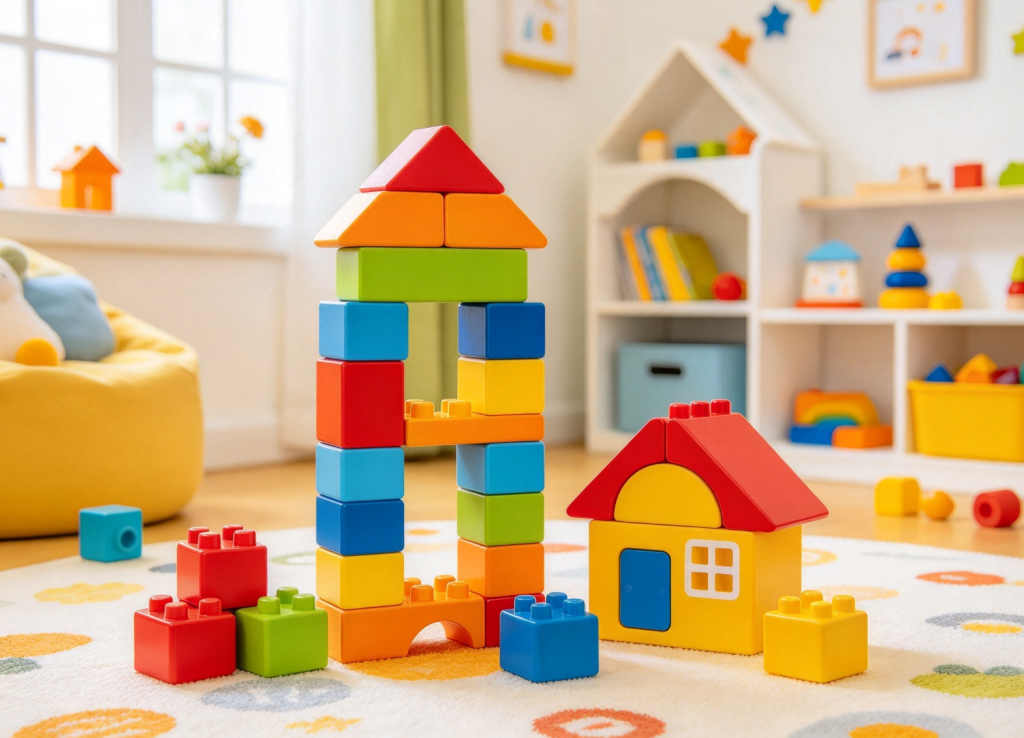
Even well-designed sets lose their shine if nothing changes. A few adjustments extend the life of any building toy:
- Rotate pieces instead of buying constantly. Put half the set away and reintroduce it in a few weeks. It often feels brand new to a toddler.
- Mix sets from different lines. Combining pieces from a few different building toy sets increases the number of possible builds without adding cost.
- Add a theme. Suggest building “a house for the dog” or “a tall tower” instead of leaving play fully open-ended. Toddlers often need a starting point.
- Build with a purpose. Use the structures in pretend play — as a garage for toy cars, a bed for a stuffed animal, or a fence for figures.
- Let them fail and rebuild. A collapsed tower isn’t a problem to fix for them. Watching a toddler troubleshoot is part of the developmental benefit.
How Do Building Toys Support Toddler Development?
Building toys do more than fill time. The physical act of picking up, aligning, and connecting pieces builds fine motor control that later supports handwriting and self-care tasks like buttoning a shirt.
There’s a cognitive layer too. Matching shapes, planning a simple structure, and adjusting when a piece doesn’t fit all require early problem-solving skills. Choosing building toys for 2 year olds that are slightly challenging — not too easy, not too hard — keeps a child in that useful zone of productive struggle.
Social development matters as well. Building side-by-side with a parent or sibling introduces turn-taking, shared attention, and basic cooperation. None of this requires narration or formal teaching. The toy does the work when it’s matched correctly to the child’s stage.
Replacing even twenty minutes of screen time with hands-on building play gives toddlers a chance to practice skills that passive viewing simply doesn’t develop. That’s the real argument for keeping a rotating set of building toys within reach at home.
Final Thoughts
Matching the toy to the stage is the single biggest factor in whether a building set gets used or ignored. Building toys for 2 year olds should prioritize size, safety, and simplicity. Building toys for 3 year olds can introduce smaller pieces, basic instructions, and themed builds without losing the child’s interest.
Start small, build alongside your child, and rotate pieces to keep play fresh. The goal isn’t a perfect structure — it’s consistent, hands-on practice that supports real developmental growth. Browse ModelBuilder’s full toddler lineup to find a set matched to your child’s current stage.
FAQ
What age should a child start using building toys?
Most children can start with oversized, toddler-safe building blocks around 18 months to 2 years old. By age 3, they’re typically ready for sets with smaller pieces and simple instructions.
Are building toys safe for toddlers under 3?
Yes, as long as the set is certified under ASTM F963 (US) or EN71 (Europe) and uses pieces large enough to avoid choking hazards. Always check the manufacturer’s recommended age range before purchasing.
How many pieces should a building set for a 3 year old have?
Somewhere between 20 and 60 pieces works well for most three-year-olds. Sets with far more pieces can lead to frustration rather than engagement at this age.
Can building toys for 2 year olds and 3 year olds come from different brands?
In many cases, yes. Standard brick sizing is common across several major brands, so pieces can often be mixed to expand build possibilities without buying an entirely new set.
How long should a toddler play with building toys in one sitting?
Two-year-olds typically stay engaged for 10 to 15 minutes, while three-year-olds can often sustain focus for 20 to 30 minutes. Shorter, more frequent sessions work better than long ones.