
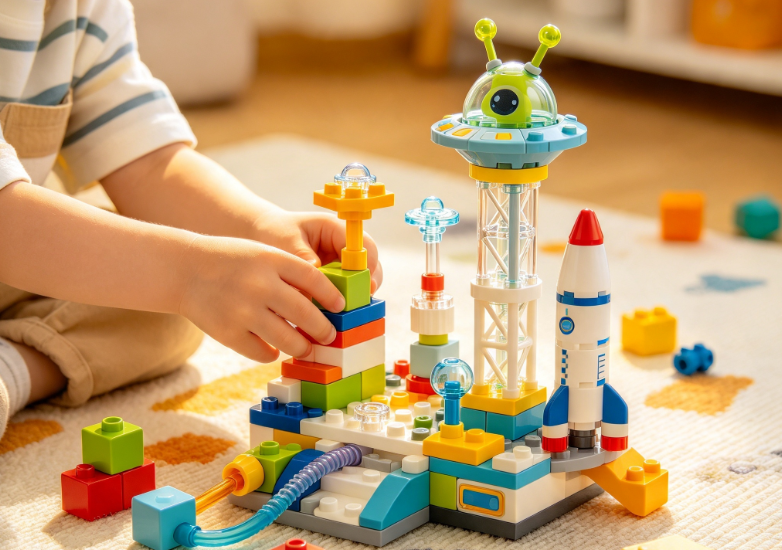
A 7-year-old finishes a fire truck set. Ten minutes later, the ladder is a dragon’s neck. The truck is a taxi for dragons. The driver is scared of heights.
Nobody planned that story. The bricks did half the work.
Imagination building toys give kids a story they can hold, take apart, and rebuild. A character gets a new hat. A castle gets a secret door. A problem shows up, and the child builds the fix. That loop of building, telling, and changing is creative thinking in action.
This guide shows parents how to turn any brick collection into a storytelling tool. You’ll get:
- A simple setup for a “story-ready” brick bin
- Character and prompt games that work in 15 minutes
- A three-scene method for building full stories
- Ways to remix instruction sets into new ideas
- Questions that grow a story instead of stopping it
Every activity works with standard stud-compatible bricks. Most use parts you already own.
What Storytelling Looks Like at Each Age
Kids tell stories differently as they grow. Match the activity to the stage, not the age on the box.
| Age | How They Tell Stories | What to Try | Adult Role |
|---|---|---|---|
| 5–6 | Short, action-heavy, one event at a time | Build one character and one problem | Ask “What happens next?” |
| 7–9 | Beginning, middle, end. Lots of side plots | Three-scene stories on separate plates | Help keep the scenes in order |
| 10–12 | Motives, twists, villains with reasons | Character cards, remix challenges | Push for a twist or a reason |
| 13–14 | Worlds with rules, history, and maps | World-building projects across many builds | Step back. Be the audience |
A quiet 10-year-old might start at the 5–6 level. A chatty 6-year-old might jump ahead. Both are fine.
Step 1: Build a Story-Ready Brick Bin
Most brick bins are full of walls. Walls don’t start stories. Characters, odd parts, and props do.
Set up one small bin just for storytelling. A shoebox works. Fill it with the parts below.
| Part Type | Story Job | Examples |
|---|---|---|
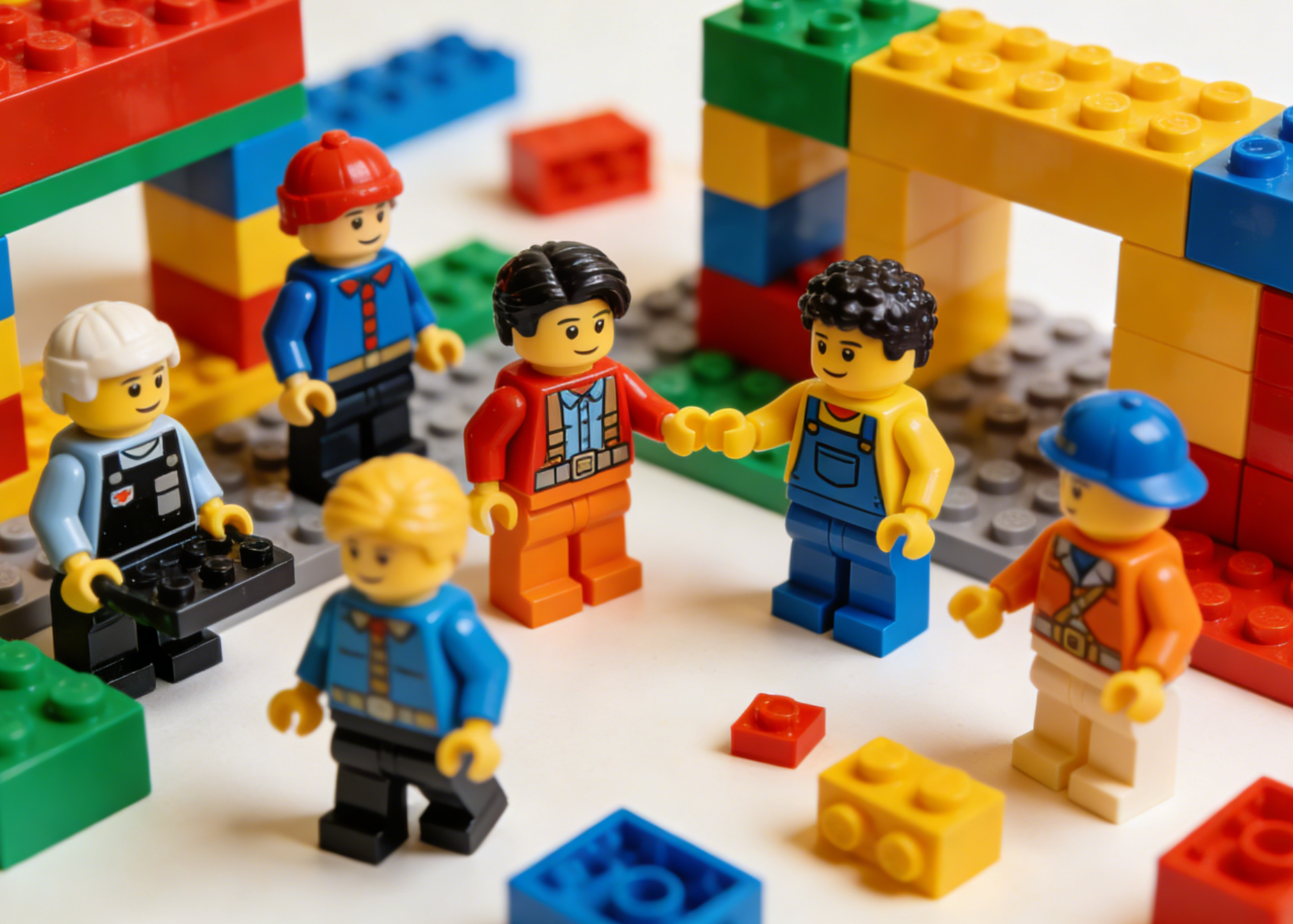
| Minifigures and animals | The characters | A knight, a chef, a dog, a robot |
| Headgear and accessories | Change who a character is | Helmets, crowns, wigs, backpacks |
| Transparent pieces | Magic, water, fire, ice, screens | Clear, blue, orange, and green bits |
| Wheels and hinges | Movement and escape | Small wheels, doors, flaps |
| “Weird” parts | Mystery objects | Gears, antennas, flower stems, odd clips |
| Small plates (4×4 to 8×8) | Mini stages for each scene | Gray, green, tan, blue |
Add a Mystery Part Cup
Pick 10 strange parts from your collection. Put them in a cup. Before each story session, a child pulls one without looking. That part must appear in the story.
A gold clip becomes a key to a sky prison. A green cone becomes a tree that grants wishes. The weirder the part, the better the story.
PRO TIP: Refill the mystery cup every week. New parts keep stories from repeating.
Sets with lots of figures, accessories, and small props stock a story bin fast. Find character-rich sets at ModelBuilder.
Step 2: Start With a Character, Not a Scene
Kids often build a big house first. Then they stare at it. Nothing happens, because nobody lives there yet.
Flip the order. Build the character first.
The Four-Line Character Card
Give each character a small index card. Fill in four lines:
- Name: Something fun to say out loud. “Captain Waffle.” “Ms. Bolt.”
- Wants: One thing they want badly. “To win the space race.”
- Fear: One thing that scares them. “Spiders. Even tiny ones.”
- Weird detail: One odd fact. “Only eats blue food.”
That’s enough. A character with a want and a fear already has a story waiting to happen.
Build One Tool
Next, the child builds one tool or vehicle for that character. Keep it under 30 pieces. Ask how the tool helps the character get what they want, and how it might fail.
- Captain Waffle builds a rocket. It only flies backward.
- Ms. Bolt builds a lightning-powered skateboard. It doesn’t work in the rain.
The flaw is the story. Kids learn quickly that problems make stories interesting.
Let Characters Change
Swap a hat, add a cape, change the face. A simple swap turns a hero into a villain or a chef into a spy. Kids practice a big creative idea here: the same parts can mean something new.
Step 3: Use Brick Story Prompts
Blank-page panic hits kids too. Prompts fix it. Write these on slips of paper and keep them in a jar next to the bin.
| Prompt Type | Example Prompts |
|---|---|
| What if… | What if the moon fell into the ocean? What if pets ran the town for one day? |
| Rescue | Someone is stuck at the top of a tower. Build the rescue. |
| Invention | The town’s bridge broke. Build something to cross the river. |
| Mystery | A strange box arrived at the bakery. What’s inside? |
| Switch | A pirate wakes up in a space station. What does she do first? |
| Size swap | Everything shrinks except one cat. |
Build Brick Story Dice
Take six 2×2 bricks. Stick a small label on each side:
- Die 1 (Who): knight, robot, grandma, dog, alien, kid
- Die 2 (Where): jungle, castle, submarine, school, desert, the moon
- Die 3 (Problem): lost, broken, stolen, trapped, too big, too fast
Stack them in a cup, shake, and roll. “A grandma, in a submarine, and something is stolen.” Now build it.
QUICK WIN: Roll the dice at breakfast. Kids build the story after school. They spend the day planning it in their heads.
Step 4: Build Stories in Three Scenes
One build is a moment. Three builds make a story. This method works for ages 7 and up.
Problem, Try, Twist
Give the child three small plates. Each plate holds one scene.
| Scene | Plate | What Happens | Example |
|---|---|---|---|
| 1. Problem | Left | Something goes wrong | The village well dries up |
| 2. Try | Middle | The character tries to fix it and struggles | A girl builds a water pump. It leaks. |
| 3. Twist | Right | An unexpected fix or surprise ending | A friendly rock giant cries, and the well fills up |
Line the plates up on a table like a comic strip. The child walks an adult through the story, plate by plate.
Keep Scenes Small
Each scene needs only 20 to 60 pieces. Small scenes finish fast, and kids care more about the story than the build. Big scenes tend to stall halfway.
Move Characters Between Plates
The same figure travels from plate to plate. Kids see their character move through time. That’s the core idea of a plot, and they learn it with their hands.
Try It as a Family
Each person builds one scene. A parent builds the problem. One child builds the try. Another builds the twist, and nobody sees the first two scenes. Put them together and read the story aloud. It rarely makes sense. It’s always funny.
Step 5: Remix Instruction Sets Into New Stories
Some parents worry that instruction sets limit creativity. They don’t, if you treat the finished model as a starting point.
Instructions teach kids building techniques. Remixing teaches them to use those techniques in new ways. The best imaginative building toys do both.
The Build-Then-Break Rule
- Build it the official way. Follow the instructions. Enjoy the finished model.
- Play with it as designed. A day or a week. No rush.
- Remix it. Take it apart and build something new with the same parts.
Remix Challenges
| Original Set | Remix Challenge | Story Hook |
|---|---|---|
| Police car | Turn it into a getaway car | Who’s escaping, and why? |
| Pirate ship | Turn it into a flying ship | Where does it fly, and who chases it? |
| House | Turn it into a haunted house | What made it haunted? |
| Space shuttle | Turn it into an underwater sub | What did they find down there? |
| Animal set | Build the animal’s home and its enemy | What does the animal protect? |
Keep the Instructions
Store the booklet in a binder. Kids can rebuild the original anytime. That safety net makes them braver about taking it apart.
🎉 Sets with lots of small, flexible parts give kids more to work with. Explore remix-friendly building sets at ModelBuilder.
Step 6: Play Creative Constraint Games
Unlimited parts can freeze a child. Limits spark ideas. These games take 10 to 30 minutes and work for mixed ages.
The 20-Piece Story
Each player gets exactly 20 pieces from the bin. Build a character, a place, and a problem using only those pieces. Then tell the story in under one minute.
One-Color Challenge
Build a whole scene in one color. An all-blue scene becomes an ice kingdom. An all-red scene becomes a volcano town. Kids invent a reason for the color, and that reason becomes the plot.
Pass the Build
Great for 3 to 5 players.
- Player 1 builds for two minutes and says one sentence of story.
- Pass the build to the next person.
- They add for two minutes and add one sentence.
- Keep going until everyone has had two turns.
Nobody controls the story. Kids practice listening, adapting, and building on someone else’s idea.
Build It Backward
Start with the ending. “The dragon and the knight become best friends.” Now build the first scene. How did they meet? Why were they enemies? Working backward teaches cause and effect.
FAMILY NIGHT IDEA: Pick one game per week. Write the winner’s story on the fridge.
Step 7: Ask Questions That Grow the Story
What the adult says matters as much as the bricks. Some questions open a story up. Others shut it down.
| Instead of… | Try… | Why It Works |
|---|---|---|
| “What is that?” | “Who lives here?” | Starts with a character |
| “That’s nice.” | “What’s the most dangerous part?” | Adds tension |
| “Put the door here.” | “How do they get inside?” | Lets the child solve it |
| “Is it finished?” | “What happens tomorrow?” | Keeps the story going |
| “That doesn’t make sense.” | “How does that work in this world?” | Invites rules and logic |
Don’t Fix the Build
A tower leans. A wing falls off. Resist the urge to repair it. Ask, “Did something happen to it?” Suddenly the broken wing is part of the story. Kids learn that mistakes can become ideas.
Be the Audience
Kids tell better stories when someone listens. Put down your phone. Sit at eye level. Ask one question at the end. That’s often all a child needs to keep going for another 20 minutes.
Build Alongside, Not For
Many parents enjoy building too. Build your own character and add it to the story. Let the child decide how your character fits in. You stay part of the fun without taking over.
Step 8: Record and Share the Stories
A story that gets saved feels important. Kids notice.
Simple Ways to Save Stories
- Photo plus caption. Snap each scene. Have the child dictate one sentence per photo. Print them as a mini book.
- Voice memo. Kids narrate the story while you record. Play it back at dinner.
- Story journal. A notebook where kids sketch the build and write the title. Reluctant writers often write more when the story already exists in bricks.
- Character hall of fame. Keep favorite figures on a shelf with their character cards.
Share With the Community
Online building communities love story builds. With parent supervision, share a three-scene story with a short caption. Kids get feedback from other builders, and they see how others tell stories with the same parts.
🏆 TRY THIS: Enter one community story challenge a month. Build it as a family. Post it together.
Real-World Scenarios
Rainy Saturday, Two Bored Kids
Roll the brick story dice. Each child builds one scene of a three-scene story. A parent builds the twist. Read it aloud before lunch. Total time: about 90 minutes.
A Reluctant Writer, Age 9
School asks for a short story. Your child stares at a blank page. Build the story first on three plates. Take photos. Now the child writes one paragraph per photo. The story is already there. They only need to describe it.
Siblings Five Years Apart
A 6-year-old and an 11-year-old rarely play the same way. Give the younger one the character job and the older one the world-building job. The 11-year-old builds the castle. The 6-year-old decides who lives there and what goes wrong.
Car Trip or Restaurant Wait
Pack a small tin with 40 bricks, three figures, and one mystery part. Use the 20-piece challenge. Kids build quietly and tell the story when it’s done.
Common Mistakes and Quick Fixes
| Mistake | What Happens | Fix |
|---|---|---|
| Starting with a huge scene | Kids stall before the story starts | Build the character first |
| Too many parts at once | Choice overload | Use the 20-piece challenge |
| Fixing the child’s build | Story stops, confidence drops | Ask a question instead |
| Only using instruction sets | Fewer original ideas | Use the build-then-break rule |
| No villain or problem | Flat, short stories | Always add a want and a fear |
| Never saving the stories | Kids stop caring about them | Photo plus one-sentence caption |
A Quick Safety Note
Standard bricks and small accessories are a choking hazard for children under 3. Keep story bins and mystery cups out of reach of toddlers. Build at a table with a tray, and sweep up after every session.
Build Stories, Not Just Models
Imagination building toys work best when kids have a reason to build. A character with a fear. A problem that needs fixing. A twist nobody saw coming. Set up a story bin. Start with characters. Use prompts, three scenes, and remix challenges. Ask questions that open the story up.
Do that each week, and you’ll see sharper ideas, longer stories, and kids who think creatively without being told to. The right imaginative building toys make every session a new story.
🧱 Start your story bin: Shop ModelBuilder
Frequently Asked Questions
What are imagination building toys?
Imagination building toys are brick sets and loose parts that kids use to create their own characters, places, and stories. They include instruction sets that can be remixed, open-ended brick collections, and sets with figures and props. The key is flexibility. Kids can build, take apart, and rebuild in new ways.
How do imaginative building toys help kids with storytelling?
They make stories physical. Kids build a character, a setting, and a problem they can see and move. That helps them understand plot, cause and effect, and how characters change. Imaginative building toys also give reluctant writers a head start, because the story exists before they write it down.
Do instruction sets limit creativity?
No. Instruction sets teach building techniques. After kids build the model as designed, they can take it apart and remix the parts into something new. Keep the instructions in a binder so they can always rebuild the original.
What age is best for storytelling with building toys?
Kids can start around age 5 with one character and one problem. Ages 7 to 9 do well with three-scene stories. Ages 10 to 14 enjoy character cards, twists, and full world-building projects. Follow the age rating on each set, and keep small parts away from children under 3.
How often should kids do story-building activities?
Short sessions of 15 to 45 minutes, two or three times a week, work well. Regular sessions build creative habits faster than one long session a month. Keep the story bin and prompt jar in an easy-to-reach spot so kids can start on their own.