
Quick answer: The best building block toys for children balance three factors: age-appropriate piece size, material safety, and design flexibility. For toddlers, choose oversized, rounded blocks free of small parts. For school-age kids, prioritize sets with instructions, compatibility with other brands, and room for creative building beyond the box. ModelBuilder offers LEGO-compatible sets built to these standards.
Parents shopping for building block toys for toddlers or older kids face a crowded market. Bricks come in dozens of sizes, materials, and price points, and not every set delivers the same value. Some fall apart after a week. Others sit in a bin, unused, because the instructions were too advanced or too simple.
This guide breaks down what to look for at every age and stage. It covers the developmental case for block play, a practical checklist for choosing sets, and specific guidance for toddlers, school-age kids, and collectors. It also introduces ModelBuilder, a LEGO-compatible brand built around safety, durability, and creative flexibility.
Whether the goal is quiet screen-free time, a STEM-focused gift, or a family activity for the weekend, this guide will help identify what are the best building block toys for kids for a given age and budget.
Why Building Block Toys Matter for Child Development
Block play does more than fill time. It builds fine motor skills every time a child pinches, twists, or snaps a piece into place. It strengthens spatial reasoning as kids figure out how shapes fit together in three dimensions. And it introduces early engineering concepts — balance, structure, load distribution — long before a child ever hears the word “physics.”
Building blocks also support open-ended play. Unlike toys with a single fixed function, blocks can become a castle one day and a spaceship the next. This kind of flexible, self-directed play is linked to stronger problem-solving skills and longer attention spans during independent activities.
For families trying to reduce screen time, block sets offer a genuine alternative. A well-designed set holds a child’s attention because it’s actually engaging, not because it’s the only option in the room. And for parents, block play is one of the few activities that scales naturally: a toddler can stack cups-sized bricks while an older sibling builds a detailed model nearby.
How to Choose the Best Building Block Toys for Kids
Not all bricks are created equal. Before buying, run through this checklist:
1. Piece size relative to age. Larger pieces suit younger children; smaller, more detailed pieces suit builders aged 6 and up who have the fine motor control and patience for intricate assembly.
2. Material safety. Look for ABS plastic that’s BPA-free and rigorously tested. Cheap alternatives sometimes use lower-grade plastic that cracks, discolors, or contains additives that fail safety standards.
3. Compatibility. Sets that connect with major existing brick systems let kids combine collections instead of starting from zero every time. This also stretches the value of a family’s existing brick collection significantly further.
4. Instructions and skill progression. A good set includes clear, step-by-step instructions but also leaves room for freeform building once the model is complete.
5. Durability. Bricks should click together with a firm, secure fit — not so tight that little hands struggle, not so loose that structures collapse.
6. Price per piece. Compare the piece count to the price. A larger set at a lower cost per piece delivers more building value long-term.
These factors apply whether shopping for a toddler’s first set or a detailed model for a teenager. Understanding what are the best building block toys for kids starts with matching these criteria to the child’s actual age and skill level, not just the box art.
Building Block Toys for Toddlers: What to Look For
Toddlers need a different set of standards than older kids. The best building block toys for toddlers meet three non-negotiable criteria:
- Oversized pieces. Blocks should be too large to pose a choking hazard, typically larger than 1.75 inches in any dimension.
- Rounded edges. Sharp corners on smaller bricks aren’t a concern for toddlers whose grip strength and coordination are still developing.
- Simple connection mechanisms. Toddlers need bricks that snap together with light pressure. A set that requires significant force to assemble or disassemble will frustrate a 2- or 3-year-old and may lead to the set being abandoned entirely.
Look for toddler-specific lines rather than scaled-down versions of adult sets. Many toy brands, ModelBuilder included, design early-years collections separately from their detailed model lines, specifically to meet safety thresholds for younger age groups.
Bright colors and simple shapes also matter more at this stage than realism or detail. Toddlers respond to primary colors and basic forms — squares, rectangles, arches — more than intricate designs they don’t yet have the coordination to appreciate.
Best Building Block Toys for Children by Age Group
Age-appropriate selection is the single biggest factor in whether a block set gets used regularly or forgotten in a closet. Here’s a general breakdown:
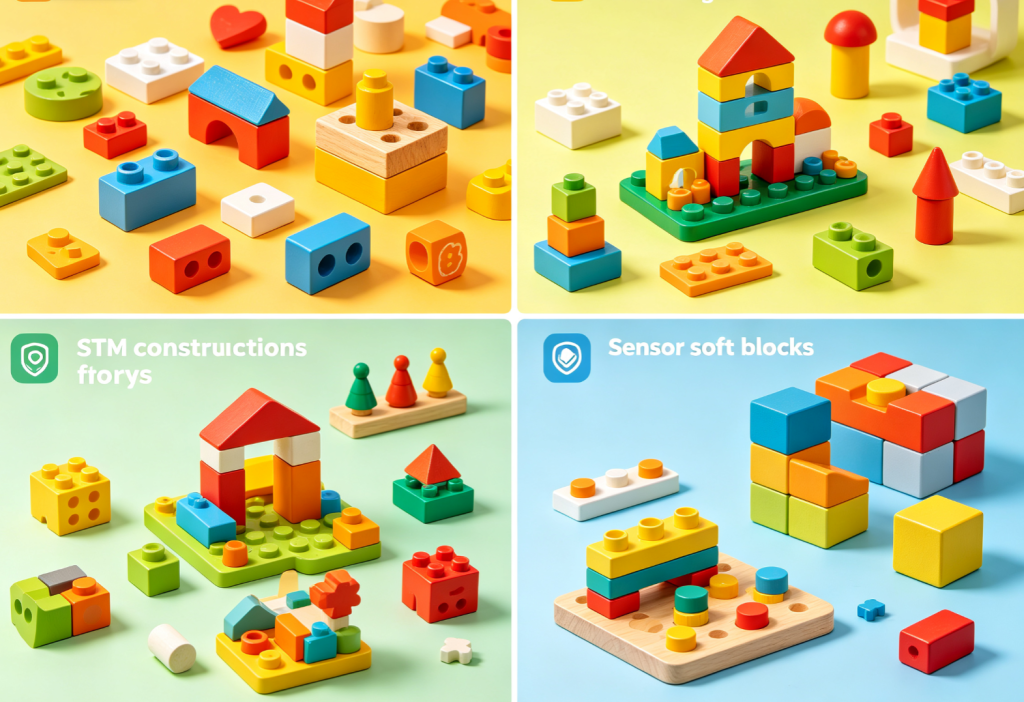
Ages 1–3: Foundational Play
Oversized blocks, simple stacking sets, and basic shape-sorting bricks. Focus on safety and simplicity over detail.
Ages 4–6: Early Builders
Medium-sized bricks with basic instructions. Kids at this age can follow simple step-by-step guides but still benefit from open-ended building. Sets with vehicles, simple buildings, or animals work well.
Ages 7–10: Skill Builders
Detailed sets with more pieces, moving parts, and thematic collections — cityscapes, vehicles, fantasy worlds. Kids in this range can handle instructions with 50–200 steps and start showing preferences for specific themes.
Ages 11+: Advanced Builders and Collectors
Complex architectural models, detailed vehicle replicas, and display-focused sets. Builders at this level often value accuracy, detail, and the finished product as a display piece rather than a toy for active play.
Choosing the best building block toys for children means matching the complexity of the set to where a child actually is, not where a parent hopes they’ll be in a year. A set that’s too advanced creates frustration; one that’s too simple gets outgrown in a week.
ModelBuilder: A Smart LEGO Alternative
ModelBuilder builds LEGO-compatible sets designed around three priorities: creative flexibility, material quality, and value for money.
Every ModelBuilder set uses ABS plastic tested for safety and durability, and every brick is designed to connect with major existing brick systems. That means a new ModelBuilder set adds to a family’s existing collection instead of starting a separate one. ModelBuilder’s collections span themed sets, custom brick options, and educational workshops built around problem-solving and hands-on design.
For families weighing cost against quality, ModelBuilder sets are built to deliver a strong piece count relative to price, without cutting corners on the plastic quality or connection strength that determines whether a set survives years of play. The brand’s collections range from beginner-friendly builds to detailed models for experienced builders, making it possible to grow with a child’s skill level over time rather than switching brands entirely.
Parents and collectors researching what are the best building block toys for kids consistently look for three things: safety, compatibility, and design variety. ModelBuilder’s full range is built around meeting all three without the premium price tag attached to some major brands.
Tips for Getting the Most Out of Building Block Play
Buying the right set is half the equation. Getting real value out of it depends on how it’s used:
- Rotate sets seasonally. Kids often rediscover a set after a few months away from it, especially once new skills or interests emerge.
- Mix collections. Combining sets from different lines encourages more creative, less instruction-bound building.
- Set aside dedicated building time. A regular weekly slot — even just 20 minutes — helps make block play a habit rather than an occasional activity.
- Display finished builds. Kids stay motivated when their work is visible, not immediately disassembled and stored away.
- Join or start a building community. Online forums and local meetups give older kids and hobbyists a place to share designs and get inspired by other builders’ work.
- Let kids deviate from instructions. The most valuable part of block play often happens after the official model is built, when a child starts modifying or rebuilding it their own way.
Choosing the Right Set Comes Down to Fit
The best building block toys for children aren’t defined by brand name alone — they’re defined by whether the set actually matches the child’s age, skill level, and interests. A toddler needs oversized, simple pieces. A ten-year-old needs detail and challenge. A teenage collector wants precision and display value.
Start with the checklist: piece size, material safety, compatibility, and price per piece. Then match complexity to the builder, not the box art. Sets that meet these standards — like those from ModelBuilder — tend to get used for years, not weeks.
Frequently Asked Questions
What age should kids start with building block toys?
Most children can safely start with oversized, toddler-specific blocks around age 1 to 2. Smaller, more detailed bricks are generally appropriate starting around age 4 to 6, depending on the child’s fine motor development.
Are LEGO-compatible brands like ModelBuilder as durable as name-brand bricks?
Durability depends on the plastic quality and manufacturing tolerances used, not the brand name alone. ModelBuilder uses tested ABS plastic and designs bricks to connect securely with major existing brick systems.
How many pieces should a first building block set have?
For toddlers, fewer than 20 oversized pieces is plenty. For children ages 4 to 6, sets between 50 and 150 pieces work well. Older kids can handle sets with several hundred pieces or more, depending on experience.
Do building block toys actually help with child development?
Yes. Block play supports fine motor skill development, spatial reasoning, and early problem-solving. It also encourages open-ended, self-directed play, which is linked to longer attention spans during independent activities.
What’s the difference between building block toys for toddlers and older kids?
Toddler sets use oversized, rounded pieces with simple connections to avoid choking hazards and match limited coordination. Sets for older kids use smaller, more detailed pieces, more complex instructions, and thematic designs suited to advancing skill levels.