
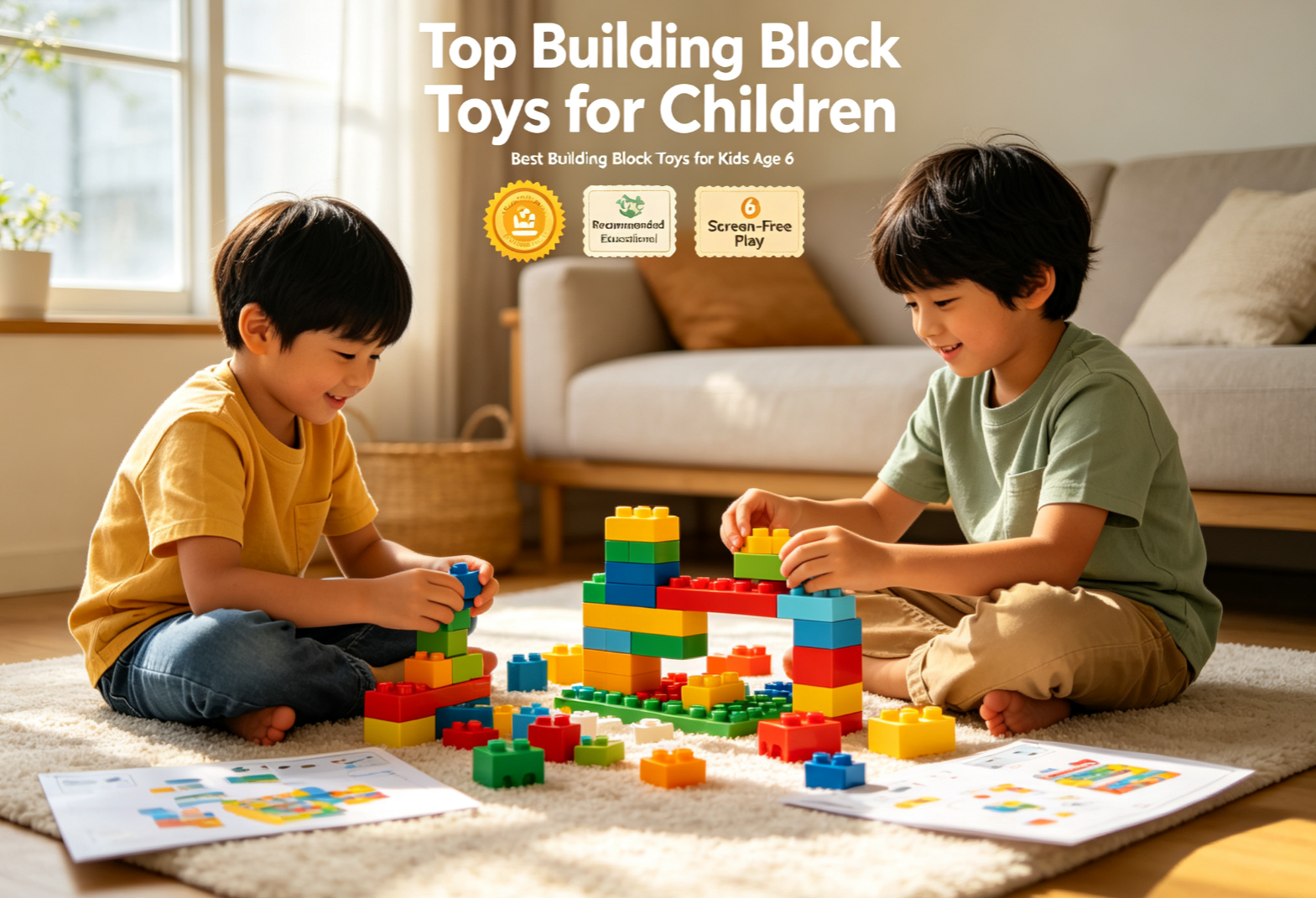
Quick answer: The best building block toys for kids age 6 combine mid-sized pieces, clear step-by-step instructions, and open-ended design options. Look for sets rated for ages 6+, made from durable ABS plastic, and free of small choking-hazard parts. Top building block toys for children should also grow with a child’s skill level, offering both guided builds and free-form creativity.
Picking a building set sounds simple until you’re standing in a toy aisle staring at fifty boxes that all promise “creativity” and “fun.” Age recommendations help, but they don’t tell you everything. A 6-year-old’s hands, patience, and problem-solving skills are different from a 4-year-old’s or a 10-year-old’s, and the wrong set can end up gathering dust in a closet.
This guide breaks down exactly what to look for when shopping for top building block toys for children, with a specific focus on what works best for 6-year-olds. You’ll get a step-by-step approach to setting up a home building space, tips for moving from simple to complex builds, and a look at ModelBuilder, a LEGO-compatible alternative built for families who want quality without the premium price tag.
How to Evaluate Top Building Block Toys for Children by Age and Skill
Age labels on toy boxes are a starting point, not a rulebook. A child’s fine motor skills, attention span, and reading level all affect how well they’ll handle a given set.
Ages 3-5: Look for oversized blocks with simple connection points. Fewer pieces, bigger pieces, and picture-based instructions work best here.
Ages 6-8: This is the sweet spot for standard-sized bricks. Kids at this age can follow numbered steps, sort pieces by color and shape, and sit through a 30- to 60-minute build.
Ages 9+: More advanced builders can handle sets with 500+ pieces, moving parts, and multi-stage assembly instructions.
When evaluating top building block toys for children, match the piece count and instruction complexity to your child’s actual attention span, not just their age on paper. A confident 5-year-old might handle a 6+ set just fine. A cautious 7-year-old might need something simpler first.
What Makes the Best Building Block Toys for Kids Age 6?
Six is a transition age. Kids are past the toddler stage of mouthing toys, but they’re still building fine motor control and reading skills. The best building block toys for kids age 6 share a few common traits.
Piece size matters. Standard interlocking bricks (roughly the size of a fingertip) are manageable for most 6-year-olds without being a choking risk.
Instructions should be visual first. Kids at this age can often follow picture-based steps faster than text-heavy manuals, since reading fluency varies widely at this stage.
Build time should match attention span. A 45-minute build with a clear result — a car, a house, a dragon — keeps kids engaged from start to finish.
Open-ended potential extends play value. The best sets don’t end when the box instructions are finished. Kids should be able to take the same pieces and build something new.
According to the American Academy of Pediatrics, hands-on play that involves problem-solving and spatial reasoning supports cognitive development in early school-age children. Building block toys check that box directly, which is part of why they remain a staple gift for 6-year-olds across Europe and North America.
How to Set Up a Building Play Environment Step by Step
A great set won’t get much use without the right setup. Here’s a simple process for creating a space that encourages regular building.
- Pick a dedicated flat surface. A table, a play mat, or a low shelf works. Consistency matters more than size.
- Sort pieces by type or color. Small bins or trays cut down on frustration during builds and make cleanup faster.
- Keep instructions visible. A clipboard or stand keeps the manual open and readable while hands are busy.
- Store finished builds somewhere visible. A shelf for completed models gives kids a reason to keep building and showing off their work.
- Rotate sets every few weeks. Keeping a few sets in a “building library” and swapping them in and out keeps interest fresh.
This kind of environment works well for ModelBuilder’s themed collections, which are designed with organized piece counts and clear numbered steps for easy sorting and storage.
How to Progress From Beginner to Advanced Builds
Kids build confidence the same way adults do: through small, repeated wins. Here’s a general progression that works for most 6- to 9-year-olds.
Stage 1 — Guided builds. Start with sets that include full step-by-step instructions and fewer than 150 pieces.
Stage 2 — Modified builds. Once a child finishes a guided set, encourage them to rebuild it differently using the same pieces.
Stage 3 — Combined sets. Mixing pieces from two or three sets introduces more complex problem-solving and larger-scale builds.
Stage 4 — Free build challenges. Give a prompt (“build a bridge that holds a toy car”) without instructions at all.
This progression matters because skill-building, not just entertainment, is often the real reason parents invest in top building block toys for children in the first place. A set that only offers one path to one outcome limits how far a child can grow with it.
What Key Criteria Should You Use to Choose Quality Building Block Toys?
Not every set on the shelf is worth the price tag. Use these criteria to filter out low-quality options.
Material durability. High-quality ABS plastic resists cracking and holds tight connections after repeated builds and rebuilds.
Piece compatibility. Sets that connect with major building block systems extend the life of a collection, since new sets add to what a child already owns instead of replacing it.
Safety certification. Look for compliance with regional safety standards, such as EN71 in Europe or ASTM F963 in the United States.
Instruction clarity. Numbered, illustrated steps reduce frustration and support independent building.
Design variety. A good product line includes vehicles, buildings, and creature builds, since kids’ interests shift often at this age.
These same criteria apply whether you’re comparing big-name brands or exploring alternatives. ModelBuilder’s custom brick sets are built around these standards, using durable, eco-friendly materials and standard piece dimensions that are compatible with most major building block systems.
Why ModelBuilder Is a Trusted LEGO Alternative
ModelBuilder positions itself as a LEGO-compatible alternative for families who want the same building experience without the premium pricing that comes with big-name branding.
The company offers three main product lines: custom brick sets tailored to specific interests, themed collections that span vehicles to fantasy creatures, and educational workshops designed to build problem-solving skills alongside the physical construction.
Every ModelBuilder set goes through a four-step production process: design concept, material selection, prototype testing, and final production quality checks. That process is built to catch design or safety issues before a set reaches a child’s hands.
Parents have noted the difference in both quality and value. As one customer, Emily Jones, put it: “As a parent, I appreciate the quality and safety of ModelBuilder’s products. They not only spark creativity in my child but also provide hours of fun.” Reviews like this reflect the two things most parents care about most: safety and lasting play value.
For families comparing top building block toys for children across brands, ModelBuilder’s full catalog is worth a look before committing to pricier name-brand alternatives.
Tips for Parents Building With Their Kids
Building together isn’t just quality time — it’s an opportunity to model patience and problem-solving.
- Let them struggle a little. Resist the urge to fix every mistake immediately. Working through a wrong piece placement builds resilience.
- Ask questions instead of giving answers. “What piece do you think comes next?” encourages independent thinking over dependence.
- Celebrate the finished build. Take a photo, display it on a shelf, or let them explain it to another family member.
- Mix building with storytelling. Ask what the finished model does or where it “lives.” This extends imaginative play beyond the physical construction.
- Set a regular building time. Fifteen minutes a few times a week builds a habit faster than one long session a month.
Start Building Confidence, One Brick at a Time
Choosing the best building block toys for kids age 6 comes down to matching piece size, instruction style, and design variety to where your child actually is — not just their age on a calendar. The right set builds fine motor skills, patience, and creative thinking all at once, and it should be flexible enough to grow with your child’s skills over the following year or two.
Whether you’re shopping for a first set or expanding an existing collection, focus on durability, compatibility, and design variety over flashy packaging. Brands like ModelBuilder offer a practical way to build that collection without paying premium prices for a name on the box.
Frequently Asked Questions
What age is best for starting standard-sized building blocks?
Most children can handle standard interlocking bricks by age 6, when fine motor skills and attention span are developed enough for 30- to 60-minute builds.
How many pieces should a set have for a 6-year-old?
Sets between 100 and 250 pieces tend to work best for 6-year-olds, offering enough complexity to stay engaging without becoming overwhelming.
Are LEGO alternatives like ModelBuilder compatible with existing LEGO sets?
Yes. Most LEGO-compatible alternatives, including ModelBuilder, use standard piece dimensions that connect with major building block systems already in a child’s collection.
How can I tell if a building block toy is safe for my child?
Check for compliance with regional safety standards such as EN71 (Europe) or ASTM F963 (United States), and confirm piece sizes are appropriate for your child’s age to avoid choking hazards.
What’s the difference between guided builds and free builds?
Guided builds follow step-by-step instructions toward a specific model, while free builds let kids design their own creations using the same pieces. Both matter for skill development at different stages.