
Quick answer: The best building blocks for 2 year olds are large, chunky, and simple — think big shapes that stack easily and can’t be swallowed. By age three, kids are ready for smaller, more varied building blocks for 3 year olds that support early STEM skills like counting, sorting, and basic construction. ModelBuilder offers safe, durable sets designed for both stages.
Watching a toddler stack a block, knock it down, and giggle is one of the simplest joys of parenting. It looks like play. It’s actually a lot more than that.
Building blocks help toddlers develop fine motor skills, hand-eye coordination, early problem-solving, and even language (every “uh-oh!” when the tower falls counts). They’re also one of the few toys that grow with your child, changing in complexity as your toddler’s abilities grow.
But not every block set works for every age. A set built for a four-year-old might frustrate or even endanger a two-year-old. And a set that’s too simple for a three-year-old can lose their interest fast.
This guide walks you through what to look for at each stage, how to introduce blocks the right way, and what safety details actually matter. We’ll also share why we built ModelBuilder’s sets specifically with young hands and growing minds in mind.
Why Building Blocks Matter for Toddler Development
Before we get into specific products, it helps to understand what’s actually happening when a toddler plays with blocks.
Between ages two and three, children go through rapid changes in motor skills, cognitive reasoning, and social understanding. Building blocks touch all three areas at once:
- Fine motor development: Grasping, stacking, and connecting pieces strengthens the small muscles in a child’s hands — skills they’ll later use for writing and self-care.
- Spatial reasoning: Figuring out how shapes fit together, balance, and stack teaches early geometry and physics, long before your child knows those words.
- Language and social skills: Playing blocks with a parent or sibling introduces new vocabulary (“stack,” “tall,” “fall”) and turn-taking.
- Confidence and persistence: Watching a tower fall and trying again teaches resilience in a low-stakes, playful way.
These benefits don’t look the same at every age, though. That’s why choosing the right set for your child’s stage matters more than you might think.
Understanding Developmental Stages: 2-Year-Olds vs. 3-Year-Olds
Toddlers change fast. The gap between a two-year-old and a three-year-old might only be twelve months, but developmentally, it can feel like a different world.
What can a 2-year-old typically do?
At this age, most toddlers:
- Can stack four to six blocks before losing balance or interest
- Still explore objects with their mouths, so size and material safety matter
- Have limited patience for multi-step tasks
- Enjoy repetitive actions, like stacking and knocking down
- Are building basic hand-eye coordination
What can a 3-year-old typically do?
By age three, children generally:
- Can stack eight or more blocks and build simple structures like towers, bridges, or walls
- Begin to follow simple instructions (“put the red block on top”)
- Show interest in color, shape, and pattern sorting
- Have better hand control, allowing them to work with smaller pieces
- Start to engage in imaginative play, like building a “house” for a toy
Knowing where your child falls on this spectrum helps you pick a set that challenges without frustrating them.
How to Choose the Right Building Blocks for 2 Year Olds
When shopping for building blocks for 2 year olds, think big, simple, and safe. Here’s what to prioritize:
1. Size matters most
Blocks for this age should be large enough that they can’t be swallowed or become a choking hazard. Chunky, oversized pieces are easier for small hands to grip, too.
2. Keep shapes simple
Basic shapes — cubes, rectangles, cylinders — are easier for two-year-olds to understand and manipulate than complex or irregular pieces. Save the intricate shapes for later.
3. Prioritize durability
Toddlers drop, throw, and chew on toys. Look for sets made from sturdy, non-toxic materials that can handle rough handling without cracking or splintering.
4. Choose bright, contrasting colors
Bold colors help toddlers visually distinguish pieces, which supports early sorting and categorizing skills.
5. Fewer pieces, less overwhelm
A smaller set (10-20 pieces) is usually plenty at this age. Too many options can overwhelm a toddler before they even start building.
If you’re building your first toddler block collection, explore ModelBuilder’s full range for sets designed with these exact priorities in mind.
How to Choose the Right Building Blocks for 3 Year Olds
Once your child turns three, you can start introducing more variety. Building blocks for 3 year olds should offer a bit more challenge while still being age-appropriate.
1. Slightly smaller pieces
Three-year-olds have better fine motor control, so slightly smaller pieces (while still larger than adult sets) keep things interesting without becoming unsafe.
2. More shape and color variety
Introducing new shapes — triangles, arches, curves — helps build spatial reasoning. More color options also support early sorting and pattern-making games.
3. Look for sets with a “building goal”
At this stage, kids enjoy working toward something, like a small house, animal, or vehicle. Sets with simple visual guides (not detailed instructions — just a picture to aim for) encourage goal-oriented play.
4. Choose expandable sets
Three-year-olds are ready to combine sets for bigger creations. Choosing a line of blocks that’s compatible across sets, like ModelBuilder’s toddler collection, means your child’s imagination isn’t limited by what’s in one box.
5. Balance challenge with achievability
The goal is to stretch skills, not create frustration. A 20-30 piece set with light variety is usually the sweet spot for this age.
Step-by-Step Guide: How to Introduce Building Blocks to Your Toddler
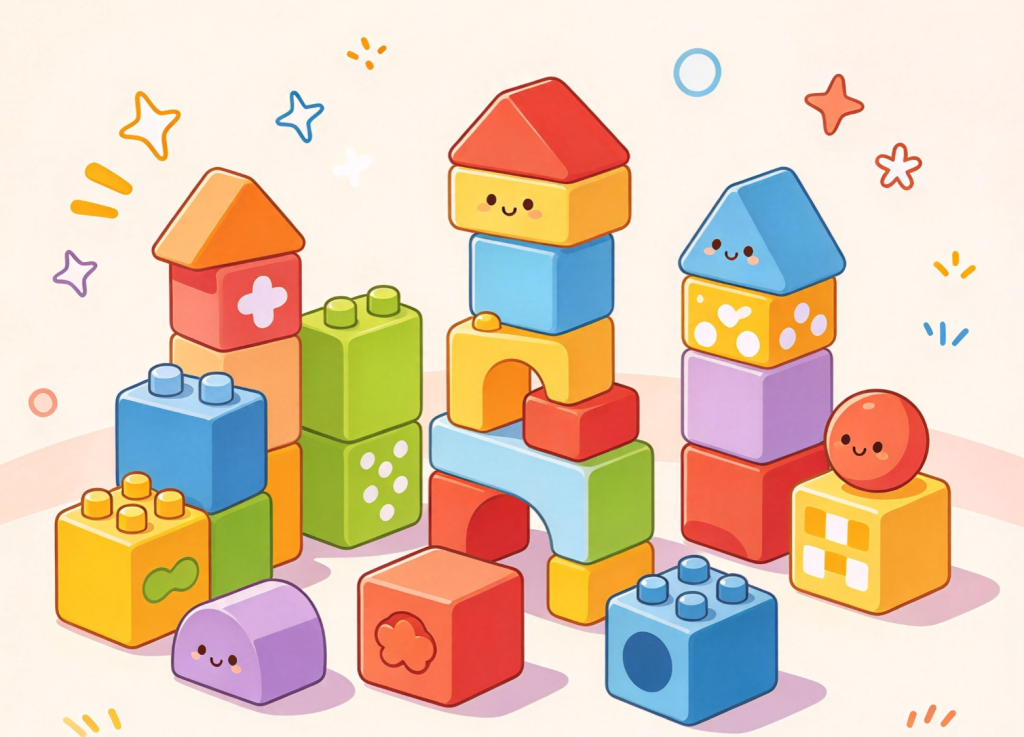
Handing your toddler a bucket of blocks and walking away rarely leads to meaningful play. A little guidance goes a long way, especially in the early stages.
Step 1: Start with free exploration.
Let your toddler touch, stack, and knock down blocks without instructions. This builds comfort with the material.
Step 2: Model simple building.
Sit down and build a small tower yourself. Toddlers learn a lot through watching and copying.
Step 3: Introduce simple challenges.
Ask your toddler to “build something taller than my hand” or “use only the blue blocks.” Keep challenges open-ended at first.
Step 4: Add language.
Narrate what you’re doing: “I’m stacking the big block first, then the small one on top.” This builds vocabulary alongside motor skills.
Step 5: Celebrate the process, not just the result.
When the tower falls (and it will), celebrate the attempt, not just a completed build. This teaches resilience early.
Step 6: Gradually increase complexity.
As your child grows more confident, introduce more pieces, new shapes, or simple “build this” pictures to work toward.
Safety Tips and What to Look For in a Quality Set
Safety should always come first when choosing toys for toddlers. Here’s what to check before buying any block set:
- Choking hazard warnings: Always check the manufacturer’s age recommendation and choking hazard labels, especially for sets with small pieces.
- Non-toxic materials: Look for BPA-free, phthalate-free plastics, and confirm the set meets safety standards for your region (such as CE certification in Europe or ASTM/CPSIA compliance in the US).
- Smooth edges: Blocks should have rounded corners and no sharp edges that could hurt small hands.
- Durability: A quality set should hold up to repeated drops, stacking, and the occasional toss across the room.
- Washability: Toddler blocks get dropped, drooled on, and dragged around. Easy-to-clean materials make a real difference.
A trustworthy set should clearly list age recommendations, safety certifications, and material information on the packaging. If that information is missing or vague, it’s worth asking the seller directly before buying.
Why ModelBuilder Is a Smart LEGO Alternative
We started ModelBuilder because we wanted families to have a safe, affordable, and creative alternative to traditional big-name brick brands.
Our toddler sets are designed with the exact priorities we’ve covered in this guide: large, safe pieces for younger toddlers, and slightly more complex, compatible sets as your child grows into preschool age. We use durable, non-toxic materials and test every set for age-appropriate safety standards across both European and American markets.
We also know building shouldn’t stop at the toddler stage. ModelBuilder’s sets are designed to grow with your child, so the blocks you buy for your two-year-old can still be part of the fun when they’re building bigger, more complex creations as an older kid.
We hope you’ll find a set your toddler loves in our full collection, and we wish your family many happy hours of building together~
If you’re looking for building inspiration beyond the toddler years, check out our guide to the best LEGO alternatives for adults too — building is a hobby that really can last a lifetime.
Frequently Asked Questions
What age should a child start playing with building blocks?
Most toddlers can start with large, simple blocks around 12-18 months, under supervision. More structured building blocks for 2 year olds work well once a child can reliably stack a few pieces without putting them in their mouth.
How many blocks should a 2-year-old’s set have?
A set of 10-20 large pieces is usually enough for a two-year-old. Too many pieces can overwhelm them before they’ve developed the patience to sort through options.
Are small building blocks safe for 3-year-olds?
Three-year-olds generally have better motor control and are less likely to put toys in their mouths, but it’s still important to check choking hazard labels. Building blocks for 3 year olds should still avoid extremely tiny pieces unless clearly rated safe for the age group.
What’s the difference between blocks for 2-year-olds and 3-year-olds?
The main differences are size, shape variety, and piece count. Sets for two-year-olds are larger and simpler, while sets for three-year-olds introduce smaller pieces, more shapes, and goal-based building.
Can ModelBuilder sets be combined with other brick brands?
ModelBuilder sets are designed to be compatible with most standard building brick sizes, giving your toddler more creative options as their collection grows.