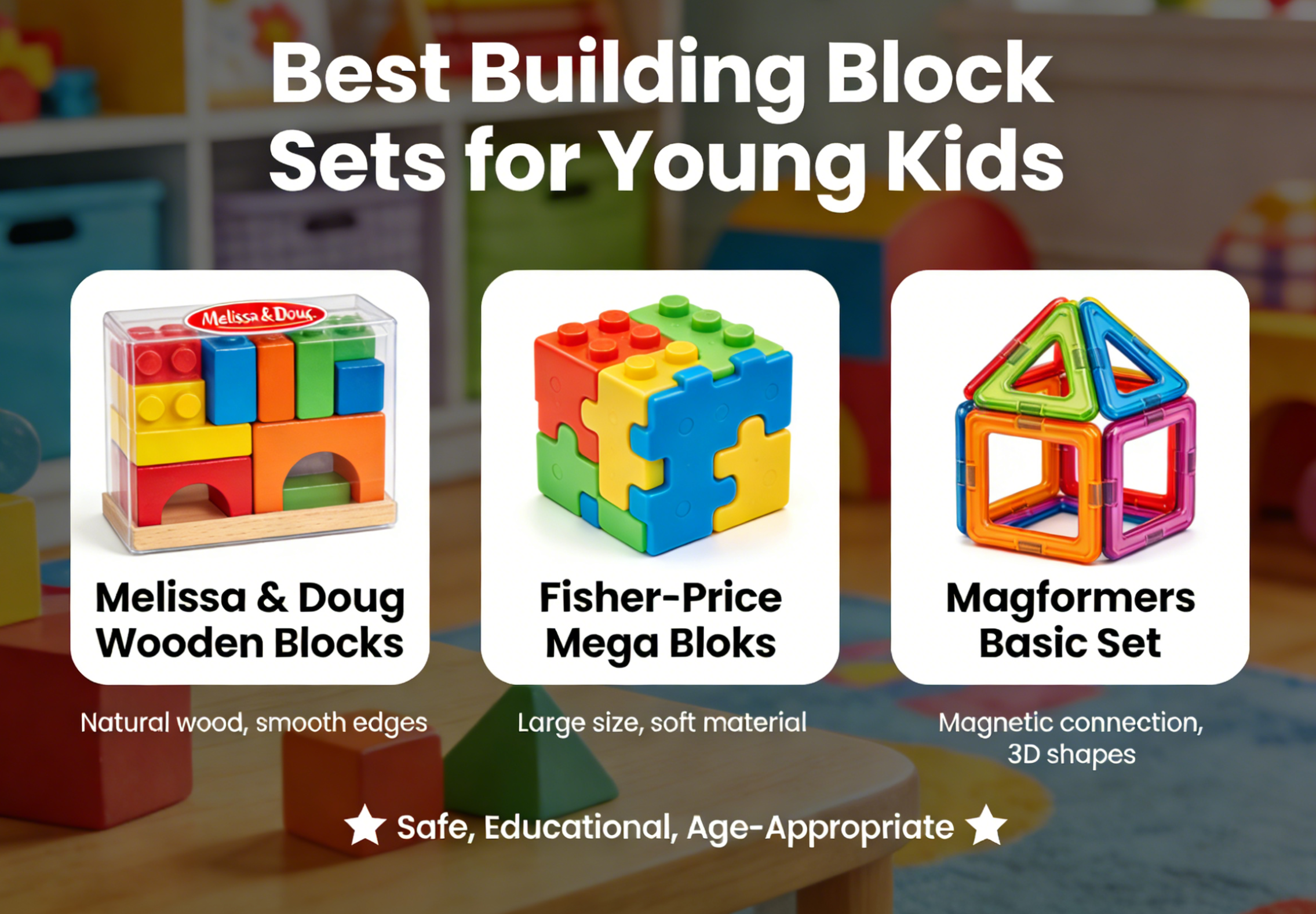

Quick answer: The best building blocks for 4 year olds are large, simple pieces that build hand strength and confidence. The best building blocks for 5 year olds add smaller pieces, instructions, and themed sets that stretch problem-solving skills. ModelBuilder offers both, as a safe, affordable LEGO alternative for growing hands and growing imaginations.
We know how fast kids change in just one year. At four, your child might still be mastering how to stack and balance. At five, they’re ready to follow a picture, build something with a plan, and show it off proudly. Building blocks grow with them, and choosing the right set can make all the difference between a toy that gets used for ten minutes and one that becomes a daily favorite.
This guide walks you through what matters most when choosing building blocks for 4 year olds and building blocks for 5 year olds. We’ll cover developmental stages, what to look for at each age, how to introduce more complex building play step by step, safety basics, and why so many families are turning to ModelBuilder as a LEGO alternative. Whether you’re buying a first set or your fifth, we hope this helps you choose with confidence.
Why Building Blocks Still Matter at Ages 4 and 5
Screens are everywhere now. That’s exactly why hands-on toys matter more, not less. Building blocks ask kids to use their hands, their eyes, and their patience all at once. There’s no autoplay button. No next level unlocks itself. Your child has to build it.
At four and five, children are developing fine motor skills, spatial reasoning, and early problem-solving. Blocks support all three. A child stacking a tower learns about balance and gravity through trial and error. A child following a simple instruction booklet learns sequencing, a skill that later helps with reading and math. And when a tower falls, as it always does, your child practices patience and resilience too.
There’s a social side as well. Building blocks are something siblings and friends can do together, or something a parent and child can sit down and share after dinner. Unlike many toys, blocks invite open-ended play. There’s no single “right” way to use them, which means your child’s imagination leads the way.
Understanding Developmental Stages: 4-Year-Olds vs. 5-Year-Olds
It’s tempting to assume four and five are basically the same age. In building terms, they’re not. A lot changes in twelve months.
At age 4, most children:
- Can stack 8 to 10 blocks without much frustration
- Are still building hand strength and precise finger control
- Enjoy open-ended play more than following strict instructions
- Benefit from larger pieces that are easy to grip and snap together
- Start naming what they build (“This is my castle!”) even if it’s simple
At age 5, most children:
- Can follow basic picture instructions with some help
- Have better finger control, so smaller pieces become manageable
- Enjoy sets with a specific theme, like vehicles, animals, or buildings
- Can concentrate on a single build for 20 minutes or longer
- Start combining sets or adding their own ideas to a finished model
Every child develops at their own pace, and that’s worth remembering. Some five-year-olds still prefer bigger, simpler pieces, and that’s completely normal. Use these stages as a general guide, not a strict rule.
How to Choose the Right Building Blocks for 4 Year Olds
When shopping for building blocks for 4 year olds, bigger is usually better. Look for pieces that are easy to grip, snap together without too much force, and won’t frustrate small hands.
Piece size matters most. At this age, oversized blocks reduce the risk of a child giving up halfway through. Standard-size bricks can feel fiddly for little fingers, while chunkier blocks let kids build quickly and see results. Quick wins keep four-year-olds engaged.
Keep instructions simple, or skip them. Four-year-olds often do better with open-ended sets that don’t require reading a step-by-step guide. A bucket of blocks in different shapes and colors encourages free building. If a set does include instructions, choose one with large, clear pictures and minimal steps.
Choose themes your child already loves. Dinosaurs, farm animals, cars, and houses are reliable favorites at this age. A theme your child recognizes gives them a starting point for imaginative play once the building is done.
Prioritize durability. Four-year-olds test toys. They drop them, step on them, and occasionally try to see if they bend. Durable, high-quality plastic blocks hold up to that kind of use far longer than cheaper alternatives.
You’ll find sets built with these exact needs in mind in our starter collections for young builders, designed with bigger pieces and simple shapes that make building blocks for 4 year olds genuinely enjoyable rather than frustrating.
How to Choose the Right Building Blocks for 5 Year Olds
By five, most kids are ready for a step up. Building blocks for 5 year olds can introduce smaller pieces, more detailed instructions, and sets that challenge their growing attention span.
Introduce smaller, more detailed pieces gradually. Five-year-olds have better fine motor control, so standard-size bricks become manageable. Still, it helps to start with sets that mix standard and larger pieces rather than jumping straight to the smallest parts.
Pick sets with step-by-step picture instructions. Following along with a booklet teaches sequencing and builds confidence. Choose instructions with clear numbering and simple illustrations, so your child can follow along mostly on their own, with you nearby for support.
Look for themed sets with a bit more complexity. Five-year-olds enjoy building something with a clear identity, such as a fire truck, a castle, or an animal habitat. These sets give kids a satisfying sense of accomplishment once finished, and often invite imaginative play afterward.
Consider sets that connect to other kits. At this age, kids start combining pieces from different sets to create something new. Choosing blocks that are compatible with each other extends playtime and encourages creative thinking beyond the instructions.
Our five-and-up building sets are designed with exactly this progression in mind, offering enough challenge to keep five-year-olds engaged without overwhelming them.
Step-by-Step Guide: How to Introduce More Complex Building Play
Moving from simple stacking to structured building doesn’t have to happen all at once. Here’s a gradual approach that works well for most families.
Step 1: Start with free building. Before introducing instructions, give your child a bucket of mixed blocks and let them build whatever comes to mind. This builds confidence and comfort with the pieces themselves.
Step 2: Introduce a simple picture guide. Choose a set with just a few steps and large, clear pictures. Sit with your child the first time and point to each step together, letting them place the pieces.
Step 3: Let them build with less help. Once your child understands how instructions work, step back a little. Offer help only when asked. This builds independence and problem-solving skills.
Step 4: Add a themed challenge. Introduce a set tied to something your child loves, like a favorite animal or vehicle. The motivation to finish something meaningful often pushes kids to tackle more steps than they would otherwise.
Step 5: Encourage combining sets. Once your child has a few completed builds, suggest combining pieces from two sets to create something new. This is where real creativity starts to show.
Step 6: Celebrate the finished build. Display it somewhere visible, take a photo, or simply ask your child to explain what they made. This reinforces pride in their work and motivates the next build.
Moving through these steps at your child’s own pace, rather than rushing to the most complex set available, keeps building blocks fun instead of frustrating.
Safety Tips and Quality Checklist
Safety always comes first, especially with younger builders. Here’s what to check before buying.
Check the age recommendation on the box. Manufacturers test sets for choking hazards and piece size based on age. Don’t assume a set is fine just because your child is advanced for their age; smaller pieces carry real risks for kids under three, and some caution is still warranted for younger four-year-olds.
Look for non-toxic, BPA-free materials. Kids put things in their mouths more than we’d like to admit. Quality blocks are made from materials that are safe even with occasional contact.
Test for sharp edges or weak connections. Good blocks should snap together firmly but not require excessive force. Edges should be smooth, with no rough seams from the manufacturing process.
Supervise younger siblings. If you have a younger child in the house, store small pieces out of reach between building sessions. Many families find storage bins with lids helpful for this exact reason.
Choose brands with clear safety certifications. Look for compliance with safety standards like ASTM F963 (US) or EN71 (Europe). These certifications mean the product has been tested specifically for children’s toys.
A quick checklist before you buy:
- Age-appropriate piece size
- Non-toxic materials
- Smooth edges and sturdy connections
- Clear safety certification
- Compatible with your child’s current skill level
Why ModelBuilder Is a Smart LEGO Alternative
We built ModelBuilder because every family deserves quality building sets without paying LEGO prices. Our sets go through the same careful process many premium brands use, starting with a detailed design concept, then moving through material selection, prototype testing, and final production. Every step matters to us, because we want every build to feel sturdy and safe in your child’s hands.
ModelBuilder sets are designed with the same developmental thinking in mind that guided this entire guide. We offer larger, simpler pieces for younger builders working on building blocks for 4 year olds, and more detailed, themed sets for growing skills with building blocks for 5 year olds. Our pieces are compatible with most standard-size bricks, so your child can combine sets, mix in pieces from other collections, and keep building new ideas long after the instructions run out.
Families who’ve tried ModelBuilder often tell us the same thing: their kids love the unique designs and creative freedom, and they feel good knowing the sets are made with safety and durability in mind. We take that trust seriously. We’re still a growing brand, and we know there’s always more we can do to make building better for your family. We hope to keep earning that trust, one set at a time.
If you’d like to see the full range, our complete catalog of building sets includes options for every stage covered in this guide, from first-time builders to kids ready for their next challenge.
Where to Go From Here
Choosing the right building blocks doesn’t have to be complicated. Start with your child’s current skill level, not their age alone. Watch how they play, and let that guide whether you pick bigger, simpler pieces or something with a bit more challenge. And remember, the goal isn’t a perfect build. It’s a child who wants to build again tomorrow.
We hope this guide helps you find a set your child loves. If you’re ready to explore options built with exactly these stages in mind, take a look at what ModelBuilder has to offer. We think you and your family will find something worth building together~
FAQ
What age should kids start using building blocks?
Most children can start with large, simple building blocks around age 2 or 3. By age 4, kids are ready for slightly more structured play, and by age 5, many can follow basic instructions on their own.
Are building blocks for 4 year olds different from blocks for older kids?
Yes. Building blocks for 4 year olds are typically larger, easier to snap together, and designed for open-ended play rather than strict instructions. As kids reach 5 and beyond, pieces get smaller and sets become more detailed.
How much should I spend on a quality building block set?
Prices vary widely, but a well-made starter set typically costs less than premium name-brand alternatives. ModelBuilder sets are designed to offer the same quality and safety standards at a more accessible price point.
Is ModelBuilder compatible with other building block brands?
ModelBuilder pieces are compatible with most standard-size building bricks, which means kids can combine sets from different collections and keep expanding their creative options.
How can I tell if a building block set is safe for my child?
Check the age recommendation on the packaging, confirm the materials are non-toxic and BPA-free, and look for a recognized safety certification such as ASTM F963 or EN71. These details are typically listed clearly on the product packaging or description.